


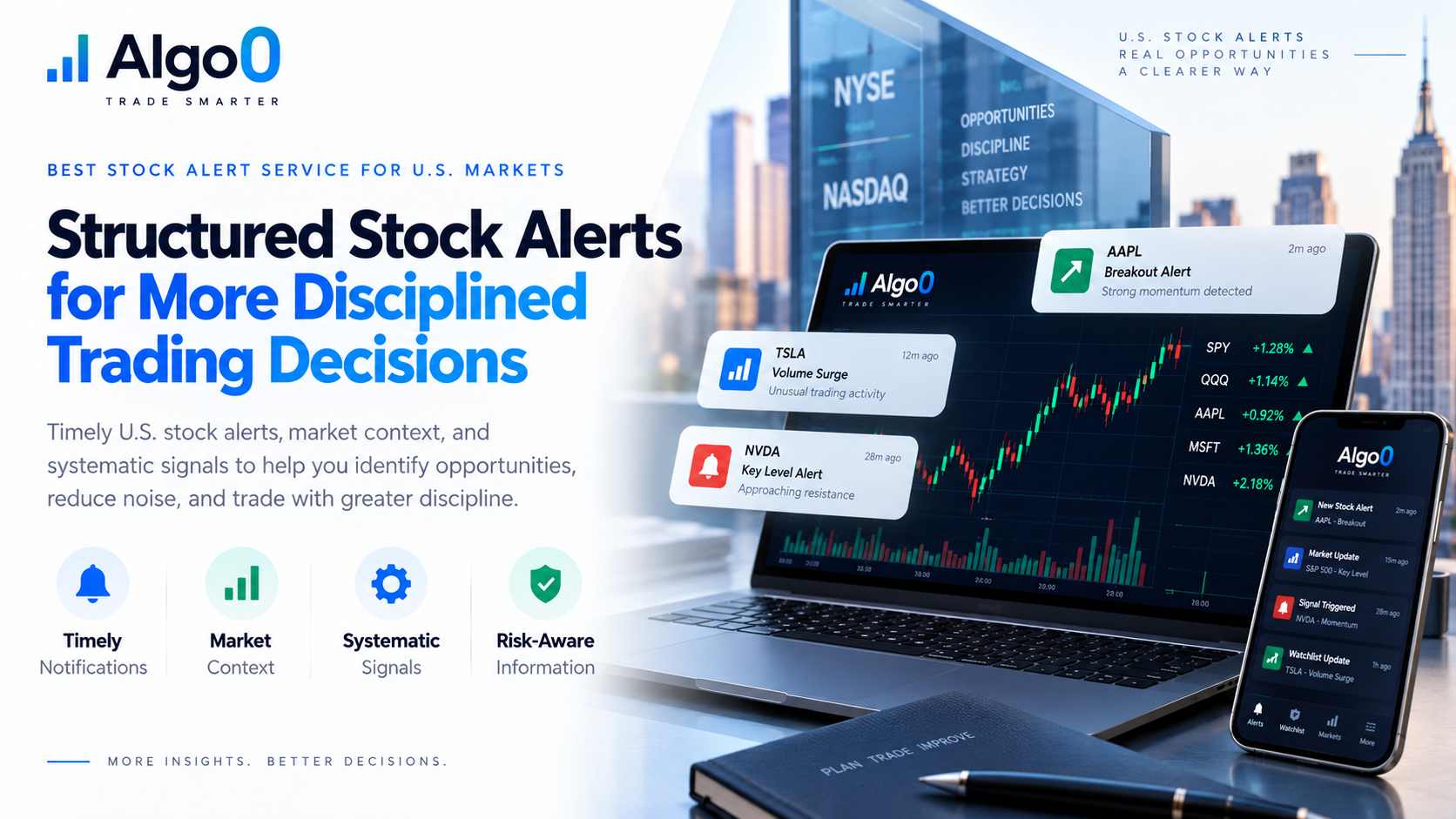
Structured Stock Alerts for More Disciplined Trading Decisions
The U.S. stock market creates thousands of potential opportunities every trading session. Algo0 provides a structured stock alert service designed to help traders and investors follow U.S. stock opportunities through systematic signals, market context, timely notifications, and risk-aware information.
Timely Notifications
Follow potentially relevant U.S. stock opportunities without constantly scanning the entire market manually.
Market Context
Understand an alert within the broader market, sector, volatility and trading environment.
Systematic Signals
Connect stock alerts with defined rules and a structured trading methodology instead of random market tips.
Risk-Aware Information
Consider volatility, liquidity, drawdown, execution uncertainty and portfolio exposure before acting.
Table of Contents
The challenge in the U.S. stock market is not simply finding information. The challenge is identifying which market movements deserve attention, when they matter, and how to evaluate them before making a trading decision.
Instead of depending on random stock tips, noisy trading communities, social-media recommendations, or constant manual market monitoring, a structured stock alert process can help traders focus on opportunities that meet defined conditions.
Algo0 is designed around this principle: better filtering, clearer context and a more disciplined process for following U.S. stock opportunities.
Why Traders Use Stock Alert Services
Active traders know how difficult it can be to monitor the entire U.S. stock market manually. Thousands of stocks can move because of earnings announcements, company news, unusual volume, technical breakouts, momentum, sector rotation, economic releases, interest-rate expectations, Federal Reserve communication, investor sentiment and unexpected market events.
A trader cannot realistically analyze every opportunity in real time. This is one of the main reasons traders use stock alert services.
What Is a Stock Alert Service?
A stock alert service is a platform or subscription that identifies and communicates potentially relevant stock-market events or trading opportunities to users.
Depending on the provider, stock alerts may include price movements, trading signals, entry or exit opportunities, breakouts, momentum alerts, market updates, technical signals, portfolio updates, trading notifications, earnings-related alerts and market-condition notifications.
Information
The service brings potentially relevant market information closer to the trader's attention.
Decision Support
The alert should help the user evaluate an opportunity rather than automatically replace the user's own decision.
The quality of a stock alert service depends on more than how quickly an alert is delivered. Context, methodology, relevance and risk communication also matter.
What Makes a Stock Alert Actually Useful?
Not every notification is valuable. A trader can receive dozens of alerts every day and still struggle to make better decisions.
A useful alert should reduce information overload rather than create more of it.
Real-Time Stock Alerts vs. Random Stock Tips
There is an important difference between a structured stock alert and a random stock tip.
A random tip may simply tell the reader to buy a particular stock. A structured alert encourages a better set of questions:
- Why this stock?
- Why now?
- What changed?
- What market condition is present?
- What is the expected timeframe?
- What risks are visible?
- Does the opportunity fit the user's strategy?
Traders do not necessarily need more market noise. They need better filtering.
U.S. Stock Alerts Built Around Market Context
A stock rarely moves in isolation. A company's share price can be influenced by the broader market, its sector, macroeconomic conditions, investor sentiment and liquidity.
Market Direction
A bullish setup may behave differently during a broad rally compared with a market selloff.
Sector Context
Sector rotation and relative strength can influence how individual stocks behave.
Volatility
High-volatility sessions can create opportunities while also increasing execution and risk.
Algo0 connects stock opportunities with a broader trading workflow rather than treating every alert as an isolated event.
How the Algo0 Stock Alert Workflow Works
The Algo0 stock alert process can be understood as a sequence that connects market conditions with opportunity identification, signals, alerts, risk context and the user's final decision.
Market Review
The broader U.S. stock market is reviewed to identify relevant market conditions and potential opportunities.
Opportunity Identification
Stocks showing potentially relevant behavior can receive attention based on the underlying process.
Rule-Based Filtering
Potential opportunities are evaluated through defined criteria rather than relying entirely on subjective reactions.
Signal Generation
When relevant conditions are met, the opportunity can become part of the trading signal or alert workflow.
Alert Delivery
The user receives the relevant information through the service.
Risk Context
The opportunity should be considered alongside volatility, drawdown, execution uncertainty, liquidity and other relevant risks.
User Decision
The user evaluates the information and decides whether the opportunity fits their own trading plan.
What Can You Monitor With a Stock Alert Platform?
A comprehensive stock alert platform can help users monitor different types of market opportunities. The exact type and frequency depend on the service configuration and methodology.
Price Movement Alerts
Notifications when a stock reaches or moves through a relevant price level.
Momentum Alerts
Notifications associated with significant changes in price momentum.
Breakout Alerts
Potential alerts when a stock moves beyond an important range or level.
Trend Signals
Information associated with potential continuation or changes in market trends.
Volatility Alerts
Notifications when volatility changes materially.
Market Alerts
Broader notifications relating to U.S. market conditions.
Trading Signals
Structured information associated with a defined trading methodology.
Portfolio Updates
Information that helps users monitor positions or portfolio-related developments.
Stock Alerts Are Not the Same as Trading Signals
The terms stock alerts and trading signals are often used interchangeably, but they can represent different things.
| Stock Alert | Trading Signal |
|---|---|
| Communicates that something noteworthy has happened or may be happening. | Usually has a more defined relationship with a trading methodology. |
| May identify unusual movement or a market event. | May identify a potential opportunity based on predefined conditions. |
| Can focus on awareness. | Can be more directly connected to a systematic trading process. |
Stock Alert Service vs. Stock Picking Service
Stock picking services and stock alert services overlap, but their primary use cases can differ.
| Stock Picking Service | Stock Alert Service |
|---|---|
| Focuses on selecting stocks that may deserve attention. | Focuses more on communicating opportunities or market developments as they occur. |
| May be useful for building a research or watchlist process. | Can be particularly useful when timing and ongoing monitoring matter. |
| Can focus on the stock selection itself. | Can combine opportunity identification with timely notifications and context. |
Algo0 combines stock opportunity identification with a broader systematic framework.
Stock Alerts vs. Manual Market Monitoring
Without an alert service, traders may spend hours scanning charts, watching price movements, reading financial news, monitoring volume, reviewing technical setups, checking watchlists and searching for breakouts.
Manual monitoring can still be valuable. However, it can become inefficient when the market generates more information than one person can reasonably process.
Why Timeliness Matters in Stock Trading
Timing is a major part of active trading. A trading opportunity can change rapidly. A stock that looks attractive at one moment may move significantly higher, reverse direction, lose momentum, consolidate, experience a volatility spike, become less liquid or react to unexpected news.
This does not mean that every alert must be treated as an instruction to act immediately.
Real-Time Stock Alerts and Execution Risk
Even when a stock alert is delivered promptly, the user's actual trade can differ from the information shown in the alert.
Therefore, a real-time alert should not be interpreted as a guarantee that the user can execute a trade at the exact price associated with the alert.
Why Too Many Alerts Can Be a Problem
More alerts do not automatically mean better trading.
A service that sends constant notifications can create alert fatigue, overtrading, decision paralysis, emotional reactions, excessive transaction activity and difficulty identifying the most important opportunities.
Signal-to-Noise Matters
The purpose of a good stock alert system should be to improve the signal-to-noise ratio, not simply increase the number of notifications.
A Better Stock Alert Workflow for Active Traders
Receive the Alert
Become aware of the opportunity.
Understand the Signal
Review what caused the alert and what the signal represents.
Review Market Context
Look at the broader market and relevant sector.
Consider Risk
Evaluate volatility, liquidity, drawdown potential and possible downside.
Check Portfolio Exposure
Consider whether the opportunity creates excessive concentration.
Compare With Your Trading Plan
Determine whether the opportunity fits your timeframe and strategy.
Make the Decision
Act, wait, investigate further or ignore the alert.
Stock Alerts for Swing Traders
Swing traders often need to monitor opportunities that may develop over several sessions or weeks.
A swing trading alert can become a trigger for further evaluation rather than an automatic instruction to trade.
Stock Alerts for Active Traders
Active traders often need more frequent awareness of market changes and may monitor intraday momentum, rapid price movements, market volatility, trading volume, breakouts, reversals, sector movements and news-driven activity.
For these users, timely notifications can be particularly valuable. However, active trading also increases the importance of execution, liquidity, position sizing and risk management.
Stock Alerts for Investors
Not every stock alert user is a short-term trader. Investors may use alerts to monitor significant company developments, major market movements, portfolio positions, sector changes, important price levels and longer-term opportunities.
The appropriate alert frequency depends on the user's objectives. The key is not receiving more information, but receiving relevant information that supports the user's process.
Why U.S. Stock Alerts Are Different
The U.S. stock market is one of the largest and most actively followed equity markets in the world. It includes large-cap companies, growth stocks, technology companies, healthcare companies, financial companies, consumer companies, industrial companies, energy companies, ETFs, momentum stocks and high-volatility stocks.
This breadth creates opportunity but also creates information overload.
Stock Market Alerts During Volatile Conditions
Volatility can create both opportunity and risk.
High volatility should never be interpreted as a guarantee of higher returns. It can increase opportunity and risk at the same time.
Stock Alerts and Risk Management
A stock alert should never be separated from risk management. Before acting on an alert, users should consider:
Risk management remains the user's responsibility. Algo0 can provide risk-aware information, but it cannot determine the appropriate risk level for every individual user.
Drawdown Matters More Than Many Traders Realize
A strategy can produce attractive historical returns while experiencing significant drawdowns. Two strategies can show similar historical returns but have very different periods of decline.
This is why users evaluating a stock alert subscription should look beyond headline performance.
Historical Results and Stock Alert Services
Historical performance can provide useful information when evaluating a methodology. But historical results are not promises.
Backtested or historical performance can differ from live trading because of execution, liquidity, transaction costs, market impact, timing, data assumptions, changing market conditions and user behavior.
Historical Performance Is Context, Not Certainty
Historical evidence should be evaluated as information about a methodology, not as a guarantee of future returns.
What Makes Algo0 More Than a Notification Tool?
A simple notification system answers: “Something happened.”
A stronger trading workflow asks: “What happened, why does it matter, what risks are involved, and how should I evaluate it?”
This distinction is central to the Algo0 approach.
Rule-Based Stock Alerts
Rule-based systems can provide consistency by applying defined criteria repeatedly. Instead of relying entirely on subjective opinions, a systematic process can evaluate opportunities according to predefined conditions.
Consistency
Defined criteria can be applied repeatedly across market opportunities.
Repeatable Analysis
A structured process makes the underlying methodology easier to evaluate.
Less Emotional Dependence
Rules can reduce reliance on purely subjective reactions to market movement.
Clearer Workflow
Defined conditions can create a more understandable path from opportunity to alert.
However, rule-based trading does not eliminate market uncertainty. A rule can identify an opportunity. The market determines what happens next.
Systematic Trading and Stock Alerts
Systematic trading focuses on applying defined rules or processes consistently. Stock alerts can serve as one output of such a system.
This can be useful for traders who prefer repeatable processes, defined criteria, structured signals, less emotional decision-making and consistent market monitoring.
Stock Alert Subscription: What Should You Compare?
Before paying for a stock alert subscription, compare more than the price.
| Factor | What to Look For |
|---|---|
| Market Coverage | Clear focus on the U.S. stocks you actually trade. |
| Alert Quality | Relevant alerts rather than excessive notifications. |
| Signal Context | An explanation around the opportunity. |
| Methodology | A defined process behind the alerts. |
| Risk Communication | Clear limitations, volatility and downside risks. |
| Performance Context | Historical results presented responsibly. |
| User Control | Support for independent decision-making. |
| Pricing | Features that are relevant to your actual trading needs. |
What Should You Look for in the Best Stock Alert Service?
There is no single service that is objectively best for every trader. The right service depends on the user's trading style, objectives, market, experience and expectations.
Serious traders can look for:
Algo0 vs. Other Stock Alert Sources
Algo0 vs. Free Stock Alerts
Free alerts can provide basic awareness, but may not always provide a consistent methodology, structured analysis, risk context, performance information or a systematic workflow.
Algo0 vs. Social Media Stock Alerts
Social media can provide ideas quickly, but users may encounter hype, unverified claims, emotional language, selective performance reporting and FOMO.
Algo0 vs. Stock Chat Rooms
Chat rooms can provide real-time discussion, but conversations may become fast, emotional, repetitive and difficult to verify.
Algo0 vs. AI Stock Pickers
AI can generate ideas quickly, but traders still need to understand methodology, data reliability, risk and portfolio fit.
Algo0 vs. Automated Stock Trading
Automated trading focuses on execution with limited manual intervention, while an alert service generally keeps the user involved in evaluation and decision-making.
Algo0 vs. Copy Trading
Copy trading replicates or follows another strategy, while an alert provides information that the user can independently evaluate.
The Role of Discipline in Stock Alert Trading
One of the potential benefits of a structured alert service can be psychological rather than purely technical.
The goal is not to eliminate emotion completely. That is unrealistic. The goal is to prevent emotion from becoming the primary trading system.
The Difference Between Awareness and Action
After receiving an alert, the user may decide to act, wait, investigate, reduce exposure, add the stock to a watchlist or ignore the opportunity.
This distinction helps keep the user in control.
A Stock Alert Does Not Guarantee a Successful Trade
Every stock signal can fail. A setup can break down because of market-wide selling, unexpected news, earnings results, sector weakness, liquidity changes, volatility, execution differences or changes in investor sentiment.
For this reason, Algo0 does not present alerts as guarantees. The service provides information and decision support. The user remains responsible for the final trading decision.
Responsible Use of a Stock Alert Service
Do Not Risk Capital You Cannot Afford to Lose
Trading involves financial risk and should be approached accordingly.
Do Not Treat Alerts as Guaranteed Instructions
An alert is information, not certainty.
Review the Broader Market
A stock should not always be evaluated in isolation.
Consider Position Size
A good opportunity can still become a poor decision if the position is too large.
Understand Your Time Horizon
Short-term trading and long-term investing have different requirements.
Maintain Independent Judgment
The user remains responsible for the final decision.
Who Is Algo0 Stock Alert Service Built For?
Active Traders
Traders who want timely U.S. stock opportunities without manually scanning the entire market.
Swing Traders
Users looking for structured opportunities that can be evaluated over multiple sessions.
Stock Alert Subscribers
Users comparing paid stock alert services and wanting more than basic notifications.
Systematic Traders
Traders who prefer defined processes and rule-based market analysis.
Investors
Users who want a structured way to monitor selected U.S. stock opportunities.
Traders Comparing Services
Users evaluating stock picks, trading signals, automated trading, copy trading and alert platforms.
Who May Not Need a Stock Alert Service?
A stock alert subscription may not be necessary for everyone.
- Users who prefer completely independent research.
- Users who already have a highly developed market-scanning process.
- Users who do not actively monitor U.S. equities.
- Users who are not comfortable making independent trading decisions.
- Users who expect alerts to guarantee profits.
The right service should fit the user's process. The goal is not to convince everyone to subscribe, but to help the right users determine whether structured stock alerts provide meaningful value.
How to Get More Value From Stock Alerts
The value of an alert depends heavily on what happens after the notification.
Receive the Alert
Identify the stock and opportunity.
Review the Reason
Understand why the stock was highlighted.
Check the Market
Consider the broader market and sector.
Evaluate Volatility
Determine whether the stock is moving under unusually volatile conditions.
Review Liquidity
Consider whether actual execution could differ materially from expectations.
Consider the Portfolio
Evaluate current exposure and concentration.
Compare With Your Strategy
Ask whether the opportunity fits your trading plan.
Make the Decision
Act only if the opportunity makes sense within your own framework.
Why Context Makes Stock Alerts More Valuable
The same stock alert can produce completely different decisions depending on the context. Imagine receiving an alert for a stock breaking above resistance.
Without context, you may simply ask: “Should I buy?”
With context, you can ask:
- Is the broader market bullish?
- Is the sector strong?
- Is volume supporting the move?
- Is volatility unusually high?
- Is the stock approaching an important event?
- Does the move fit my timeframe?
- What could invalidate the setup?
Stock Alert Service and Market Timing
No service can consistently predict the exact top or bottom of the market. Market timing is inherently uncertain.
Structured signals can nevertheless help users identify moments when market behavior meets predefined conditions.
Stock Alerts and Portfolio Management
A trading opportunity should not be considered independently from the user's existing positions.
Several individual alerts may involve stocks from the same sector. Following every alert could unintentionally create:
Users should therefore consider the portfolio-level impact of individual trading decisions.
Stock Alert Services and Trading Psychology
Markets can create powerful psychological pressure.
A systematic stock alert service cannot eliminate these emotions. But a defined process can help users create distance between market movement and immediate emotional reaction.
Transparency Before Subscription
Before purchasing a stock alert subscription, users should know:
Transparency matters because users should understand the service before committing to it.
Why Pricing Should Be Evaluated With the Service
The cheapest stock alert service is not automatically the best value. Likewise, the most expensive service is not automatically the most useful.
Compare the subscription based on:
- Alert quality.
- Market coverage.
- Methodology.
- Signal context.
- Risk information.
- Performance transparency.
- User experience.
- Support.
- Frequency of relevant opportunities.
From Stock Alerts to a Complete Trading Workflow
A stock alert should be part of a broader process.
This allows users to evaluate the service before committing.
Why Methodology Matters
A stock alert without a methodology is difficult to evaluate. Users should understand the process behind the alerts.
The Algo0 methodology page provides additional context for users who want to understand the framework behind the service.
Why Performance Matters
Performance provides historical context, but performance should never be considered separately from drawdown, volatility, time period, market environment, methodology, execution and the distinction between historical and live results.
Returns
Review historical results within the correct time period and market environment.
Drawdown
Understand periods of decline rather than focusing only on headline returns.
Methodology
Understand the process that produced the historical observations.
Why Risk Disclosure Matters
A serious trading service should make risk visible.
Review the full Algo0 Risk Disclosure before making a subscription or trading decision.
A Better Way to Compare Stock Alert Platforms
Use the following framework when comparing stock alert providers.
| Factor | What to Look For |
|---|---|
| Market | Clear focus on the U.S. stock market. |
| Alerts | Relevant rather than excessive. |
| Signals | Defined methodology. |
| Context | Explanation around opportunities. |
| Risk | Clear risk communication. |
| Performance | Historical results shown responsibly. |
| Workflow | Easy transition from alert to evaluation. |
| Control | User retains decision-making. |
| Pricing | Clear subscription structure. |
| Transparency | No unrealistic profit promises. |
The strongest provider is not necessarily the one with the loudest marketing. It is the one that makes the entire decision process easier to understand.
Frequently Asked Questions
What is the best stock alert service?
The best stock alert service depends on the trader's objectives, strategy, market, experience and preferred workflow. A strong service should provide relevant alerts, defined methodology, market context, risk awareness and transparent information rather than simply promising profitable trades.
What is a stock alert service?
A stock alert service monitors or identifies relevant market opportunities and communicates them to users through notifications, alerts, signals or updates.
What are stock trading alerts?
Stock trading alerts are notifications related to potentially relevant stock-market movements, setups, signals or trading opportunities.
What are real-time stock alerts?
Real-time stock alerts are notifications designed to communicate relevant market information as close as practical to the time the underlying event or condition occurs. Actual timing can be affected by technology, data, market conditions and delivery systems.
Are stock alerts guaranteed to make money?
No. Stock alerts do not guarantee profitable trades or future returns. Every trading decision involves risk.
Are trading signals the same as stock alerts?
Not necessarily. An alert can identify something noteworthy, while a trading signal may represent a more defined opportunity generated by a specific methodology.
What is the difference between a stock alert service and a stock picking service?
A stock picking service generally focuses on selecting stocks, while an alert service focuses more on communicating opportunities or market developments. Some services combine both functions.
Are paid stock alerts better than free stock alerts?
Not automatically. The value of a paid service depends on the quality of its methodology, relevance of alerts, context, risk communication, transparency and usefulness to the individual trader.
How many stock alerts should I receive?
There is no universal ideal number. Excessive alerts can create alert fatigue and encourage overtrading. Relevance is generally more important than volume.
Are stock alerts useful for swing trading?
They can be. Swing traders may use alerts to identify potential trends, breakouts, pullbacks, momentum changes and other opportunities for further evaluation.
Can beginners use stock alert services?
Beginners can use structured information, but they should first understand basic market concepts, trading risk, position sizing and personal responsibility. An alert should not be treated as a guaranteed instruction.
Does Algo0 guarantee trading profits?
No. Algo0 does not guarantee profits, specific returns, successful trades or future performance.
Does Algo0 automatically execute trades?
The specific level of automation depends on the service and the user's chosen features. Users should review the applicable service details to understand what is automated and what remains under their control.
Is Algo0 a stock-picking service?
Algo0 can help users identify and evaluate U.S. stock opportunities through its structured trading workflow, but users should understand the distinction between information, signals and personalized investment advice.
Can I use stock alerts without trading every alert?
Yes. An alert is information. Users can review it, investigate it, add it to a watchlist, wait or decide not to act.
What should I look for in a trading signal service?
Look for a clear methodology, relevant signals, market context, risk information, historical performance context, transparency and a workflow that supports independent decision-making.
Are stock alerts suitable for long-term investors?
They can be useful for monitoring selected market events or opportunities, but long-term investors may have different information needs from active traders.
What risks are associated with stock alerts?
Risks include market risk, volatility, execution risk, liquidity risk, gap risk, timing differences and the possibility that a signal or opportunity does not produce the expected result.
Can a stock alert replace financial advice?
No. A stock alert is not a substitute for personalized financial advice. Users remain responsible for evaluating their own financial circumstances and decisions.
Start With a Better Stock Alert Process
The goal of a stock alert service should not be to make the market look predictable. It should make the market easier to monitor and evaluate.
Algo0 brings together U.S. stock alerts, trading signals, market context, rule-based methodology, performance awareness, risk context, portfolio considerations and user decision-making.
You do not need every market notification. You need the information that deserves your attention.
Evaluate Algo0 Before You Subscribe
Before subscribing, explore the complete decision path:
Review the Methodology
Understand the framework behind the trading process.
Review Performance
Evaluate historical results in context.
Read the Risk Disclosure
Understand the risks and limitations.
Compare Pricing
Review the available subscription options.
Evaluate Your Fit
Consider your objectives, experience, strategy and risk tolerance.
Make Your Decision
Decide whether the service fits your own trading process.
Get Stock Alerts With More Context
Better information. Clearer context. More disciplined decisions. Explore the Algo0 approach to structured U.S. stock alerts before you subscribe.
Important Risk Disclosure
Trading U.S. stocks involves risk, including the possibility of loss of capital. Stock alerts, signals and historical or backtested performance do not guarantee future results. Information provided by Algo0 is intended to support the user's evaluation and decision-making process and should not be interpreted as a guarantee of profit or personalized financial advice. Users remain responsible for their own trading decisions, portfolio exposure, position sizing, execution and risk management.
For additional information, please review the Algo0 Risk Disclosure before subscribing or trading.