


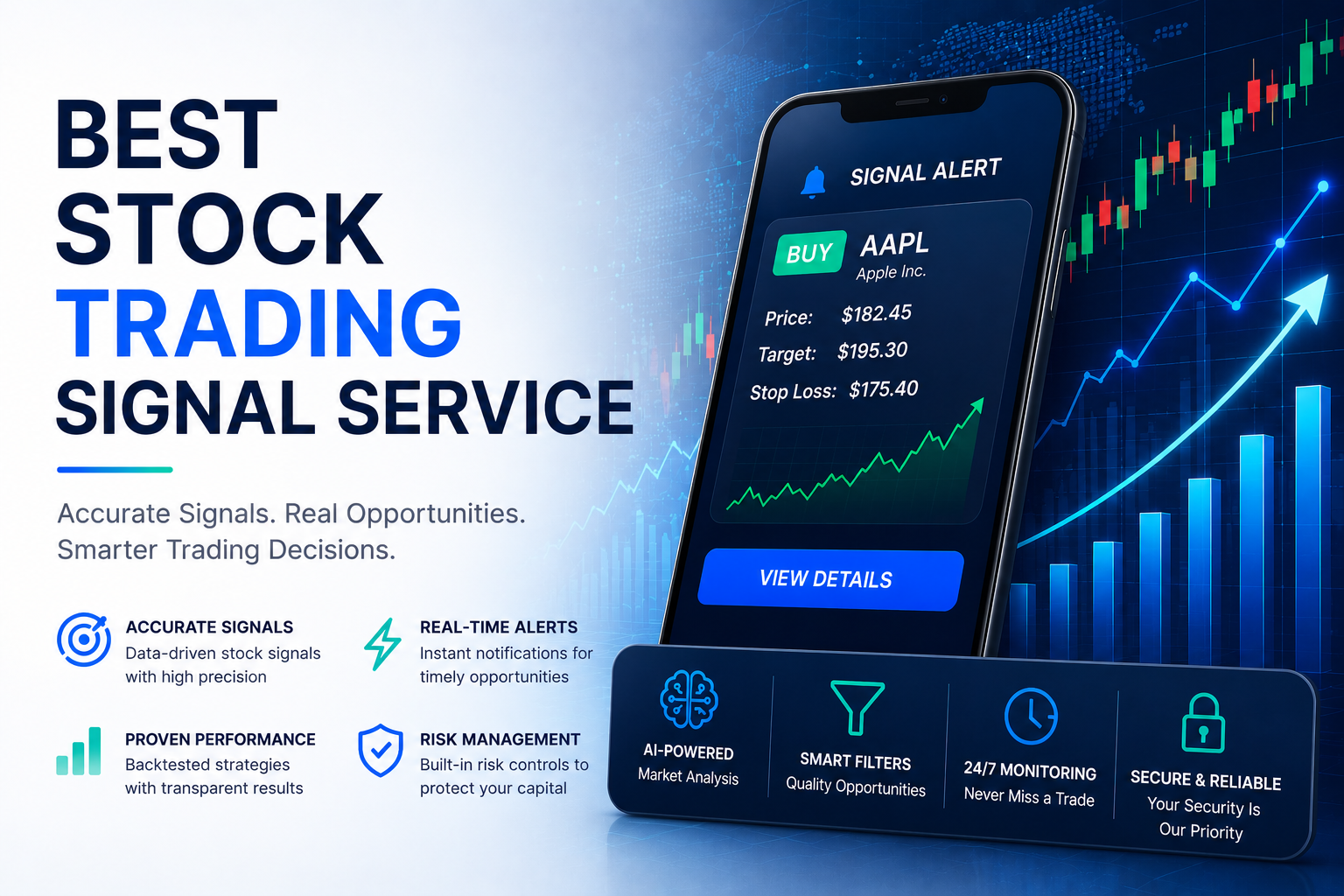
Best Stock Trading Signal Service for U.S. Stocks
Finding the best stock trading signal service is not simply about receiving more alerts. The real value comes from receiving structured signals, meaningful market context, disciplined timing, and clear risk information that can support better trading decisions.
- What Is a Stock Trading Signal Service?
- What Makes a Good Stock Trading Signal?
- How Stock Trading Signals Work
- Why U.S. Market Context Matters
- Real-Time Stock Trading Alerts
- Risk Management and Signal Services
- Signals vs Picks vs Bots vs Automated Trading
- How to Evaluate a Signal Provider
- Common Mistakes When Choosing Signals
- How Algo Approaches Stock Signals
- Frequently Asked Questions
What Is a Stock Trading Signal Service?
A stock trading signal service provides alerts or notifications that highlight potential trading opportunities. Depending on the provider, signals may be based on technical indicators, quantitative models, market conditions, price behavior, momentum, volatility, or other predefined methodologies.
The purpose of a signal is not necessarily to make the trading decision for you. Instead, a useful signal can help identify an opportunity and provide information that allows a trader or investor to evaluate whether the setup fits their strategy, risk tolerance, and portfolio.
Opportunity Identification
Signals can help traders identify stocks or market setups that deserve further attention without manually scanning hundreds of securities.
Decision Support
A structured alert can organize relevant information so the trader can make a more informed decision.
Timing Awareness
Timely notifications can be particularly useful in markets where prices and volatility can change quickly.
Reduced Manual Screening
Systematic scanning can reduce the amount of repetitive market research required before a potential setup is reviewed.
What Makes a Good Stock Trading Signal?
Not every stock alert has the same quality. When comparing the best stock trading signal services, it is useful to look beyond the number of alerts being delivered.
Clear Methodology
A provider should be able to explain the general methodology behind its signals and what type of market behavior it is designed to detect.
Signal Timing
Timing matters because market conditions can change rapidly. A useful signal should arrive early enough to be evaluated and acted upon.
Relevant Market Context
A signal should not be considered in isolation. Earnings, interest rates, sector rotation, liquidity, volatility, and broader market trends can all influence price behavior.
Risk Information
Good decision support includes awareness of downside risk rather than focusing exclusively on potential upside.
How Stock Trading Signals Work
A systematic signal service can be viewed as a workflow that moves from broad market scanning to a filtered opportunity and finally to a user decision.
Market Scan
The market is screened for relevant price and market conditions.
Filtering
Potential opportunities are filtered using predefined criteria.
Signal
A qualifying setup generates a structured trading notification.
Context
The opportunity can be evaluated alongside market and risk context.
User Decision
The trader decides whether the opportunity fits their own approach.
Why U.S. Market Context Matters
The U.S. stock market can move quickly in response to company earnings, economic releases, Federal Reserve decisions, interest-rate expectations, sector rotation, institutional activity, liquidity changes, and shifts in investor sentiment.
Because of this, a stock signal should ideally be considered within its broader market environment rather than treated as an isolated instruction.
Real-Time Stock Trading Alerts
Timing is one of the most important characteristics of a stock signal service. A delayed notification can be significantly less useful than an alert delivered while the opportunity is still relevant.
Depending on the service and subscription plan, notifications may be delivered through channels such as email, messaging applications, or other communication systems.
Faster Awareness
Receive notifications when a qualifying setup is detected instead of continuously monitoring the market manually.
Less Information Overload
Structured alerts can help focus attention on opportunities that meet predefined criteria.
Risk Management and Stock Trading Signals
No stock trading signal can eliminate market risk. Even a signal based on a well-defined methodology can produce losing trades because market conditions are uncertain and historical behavior does not guarantee future outcomes.
This is why risk awareness should be part of the process. Traders should consider position sizing, portfolio exposure, volatility, liquidity, downside scenarios, and their own risk tolerance before acting on a signal.
Position Size
The size of a position can have a major impact on the overall effect of a winning or losing trade.
Portfolio Exposure
Multiple signals may create concentrated exposure to the same sector or market factor.
Volatility
Higher volatility can increase both opportunity and potential downside.
Exit Planning
Traders should understand how they intend to manage a position before entering a trade.
Stock Signals vs Picks vs Bots vs Automated Trading
These terms are often used interchangeably, but they describe different approaches to trading decision support and execution.
| Approach | Primary Purpose | Human Decision | Automation |
|---|---|---|---|
| Stock Alerts | Notify users about market events or price conditions. | Usually required | Low |
| Stock Picks | Highlight stocks that may be worth considering. | Required | Low |
| Trading Signals | Identify structured trading opportunities. | Usually required | Medium |
| AI Trading Bot | Analyze markets and potentially automate parts of the process. | Depends on implementation | High |
| Automated Trading | Execute predefined strategies automatically. | Strategy-dependent | Very High |
How to Evaluate the Best Stock Trading Signal Service
Before subscribing to any stock signal provider, evaluate the service based on its methodology, transparency, delivery system, risk approach, and how well it fits your own trading process.
1. Understand the Methodology
Look for a clear explanation of how signals are generated and what type of market conditions the system is designed to identify.
2. Check Signal Delivery
Understand how alerts are delivered and whether the timing works with the way you trade.
3. Review Historical Evidence
Historical or backtested information can help evaluate a methodology, but it should never be interpreted as a guarantee of future performance.
4. Look at Risk Disclosure
A professional provider should clearly communicate that markets carry risk and that outcomes are not guaranteed.
5. Understand Subscription Terms
Check exactly what is included in the subscription, how signals are delivered, and whether execution is manual or automated.
6. Consider Portfolio Fit
A signal can be interesting without being suitable for every investor. Consider your objectives, time horizon, capital allocation, and risk.
Common Mistakes When Choosing Stock Signals
Chasing Guaranteed Returns
No legitimate stock signal service can guarantee profits. Markets remain uncertain even when signals are generated systematically.
Focusing Only on Win Rate
Win rate alone does not describe the complete risk and return profile of a trading methodology.
Ignoring Drawdowns
Historical drawdowns and losing periods are important when evaluating any trading strategy.
Following Every Signal Blindly
Signals should be evaluated against your own portfolio, strategy, position sizing, and risk management process.
Who Can Benefit From a Stock Signal Service?
A structured signal service may be useful for traders and investors who want systematic market screening without spending the entire trading day manually monitoring U.S. stocks.
Active Traders
Traders looking for structured alerts that can complement their existing technical or quantitative workflow.
Busy Investors
Investors who cannot continuously monitor hundreds of U.S. stocks throughout the trading session.
Systematic Traders
Traders interested in rule-based approaches rather than purely discretionary decision making.
Strategy Researchers
Users interested in understanding how systematic signals can fit into a broader market research process.
How Algo Approaches Stock Trading Signals
Algo focuses on systematic U.S. stock portfolio strategies and structured trade notifications rather than relying on random stock tips or promises of guaranteed returns.
The company's systems have been developed and backtested over many years using historical U.S. market data. Signals and portfolio transactions can then be followed through the available Algo service, with subscribers receiving trade notifications through supported communication channels.
Frequently Asked Questions
What is the best stock trading signal service?
The best service depends on your trading objectives, preferred market, risk tolerance, methodology, signal timing, transparency, and delivery system. A strong provider should offer a clear methodology rather than simply promoting a large number of alerts.
Are stock trading signals profitable?
Signals can identify potential trading opportunities, but profitability is never guaranteed. Market conditions change and historical or backtested results do not guarantee future performance.
Are stock signals the same as stock picks?
Not necessarily. A stock pick may simply identify a company or security, while a trading signal can contain more structured information about a potential trading setup.
Can stock trading signals be automated?
Some services support automated execution, while others provide notifications that users execute manually. The available functionality depends on the provider and subscription plan.
Does Algo provide stock trading signals?
Algo provides structured trade notifications related to its U.S. stock portfolio strategies. Depending on the plan, subscribers can receive trade information and may have access to automated execution options.
Do stock signals guarantee profits?
No. Stock market investing involves risk, and no signal service can guarantee profits or eliminate the possibility of losses.
Should I follow every trading signal?
No. Signals should be evaluated within your own investment objectives, portfolio exposure, position sizing, and risk management framework.
Final Takeaway
The best stock trading signal service is not necessarily the one producing the most alerts or making the biggest performance claims. The more important question is whether the service provides a structured, transparent, and repeatable way to identify and evaluate opportunities.
For U.S. stock traders, useful signal services should combine timely notifications with a clear methodology, relevant market context, and appropriate risk awareness.
Ultimately, signals are decision-support tools. They should complement a disciplined trading process rather than replace sound risk management.
Explore Algo's U.S. Stock Trading Strategies
Discover Algo's systematic approach to U.S. stock portfolios, trade notifications, and automated execution options.