


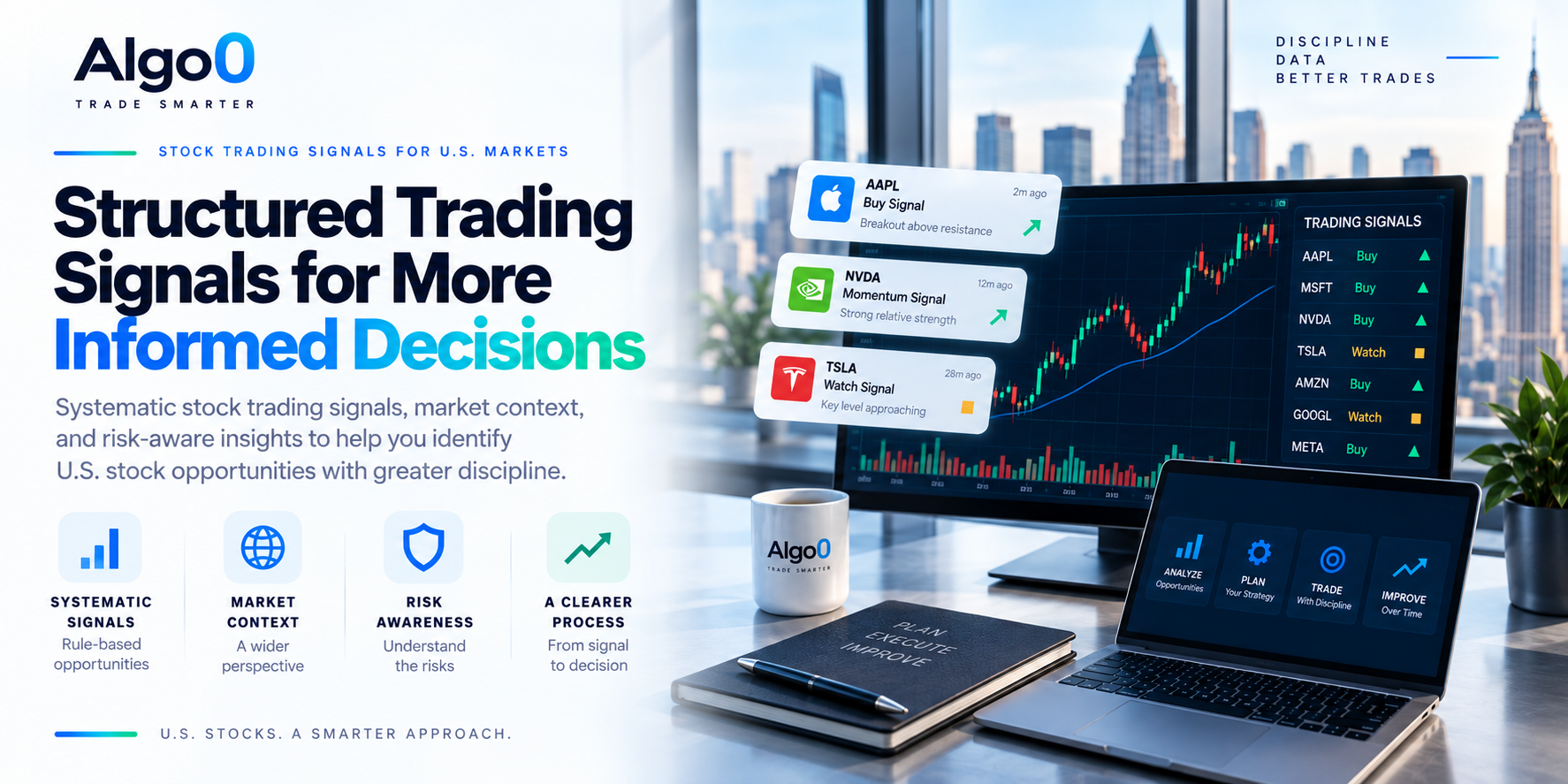
Structured Trading Signals for More Informed Decisions
The U.S. stock market moves quickly. Earnings reports, Federal Reserve decisions, economic data, sector rotation, liquidity changes, price momentum, market sentiment, and unexpected events can all change a trading opportunity within a single session.
Systematic Signals
Rule-based opportunities designed around defined market conditions rather than random market opinions.
Market Context
Understand individual stock opportunities within broader U.S. market and sector conditions.
Risk Awareness
Review volatility, liquidity, drawdown, execution uncertainty, and portfolio exposure.
Clearer Process
Move from signal to review, evaluation, and independent decision instead of automatic reaction.
What Are Stock Trading Signals?
Stock trading signals are structured indications that help traders identify and evaluate potential opportunities in the stock market.
A trading signal may be associated with specific market conditions, price behavior, momentum, technical patterns, or other defined criteria.
However, a useful trading signal should provide more than a stock ticker. Traders may also want to understand why the signal appeared, what market conditions surround it, what risks should be considered, and whether the opportunity fits their own strategy.
Why Do Traders Use Stock Trading Signals?
Following thousands of U.S. stocks manually can require significant time and attention. Companies across technology, financial services, healthcare, energy, consumer sectors, industrials, and communications can behave very differently.
Individual stocks can respond to earnings, sector strength, market direction, interest rates, liquidity, investor sentiment, economic releases, company-specific news, and technical momentum.
Instead of attempting to monitor every stock, traders can begin with a more focused list of opportunities that meet defined criteria and then perform additional evaluation.
The Problem Is Not a Lack of Information
Modern traders have access to more financial information than ever: breaking news, analyst opinions, technical charts, stock screeners, trading communities, social media posts, market alerts, AI-generated stock ideas, financial commentary, and earnings updates.
More information does not automatically produce better decisions. Without a consistent filter, every price movement can appear important.
The goal is not to eliminate uncertainty, but to turn a large amount of market information into a process that can be reviewed more consistently.
A Clearer Way to Read U.S. Stock Opportunities
A stock can move because of strong earnings, increased trading volume, technical momentum, sector strength, positive news, market-wide movement, institutional activity, or changing investor sentiment.
Knowing that a stock is moving is only the beginning. The more important question is what that movement means within the broader market context.
From Movement to Meaning
A structured trading signal can place a potential opportunity inside its broader market context, making it easier to distinguish between random price movement and a condition that deserves further attention.
How Algo0 Generates a Structured Trading Signal
The exact role of a signal depends on the underlying methodology, but the process can be understood as a series of connected stages.
Review the U.S. Market
Consider market direction, sector behavior, volatility, liquidity, price behavior, and general market conditions.
Filter Opportunities
Evaluate potential opportunities against defined criteria so every market movement is not treated as a trading opportunity.
Apply Rule-Based Logic
Evaluate selected opportunities through a structured methodology rather than relying only on subjective opinions.
Generate the Signal
When an opportunity meets the relevant criteria, it can become part of the signal output.
Review Risk & Context
Consider volatility, liquidity, drawdown, market conditions, and execution uncertainty.
User Evaluation
The user decides whether the opportunity fits their own strategy, objectives, and risk tolerance.
What Makes a Trading Signal Useful?
Not every stock signal provides the same level of value. The process behind the signal should be evaluated alongside the signal itself.
Rule-Based Stock Trading Signals
Rule-based trading signals use predefined criteria to identify market conditions that may deserve attention.
Depending on the methodology, rules may consider:
- Price behavior
- Momentum
- Trend
- Relative strength
- Volatility
- Market direction
- Sector conditions
- Quantitative measurements
The advantage of a rule-based framework is not that it makes the market predictable. Instead, it creates a repeatable process for evaluating opportunities.
What Is Signal Generation?
Signal generation is the process of converting market data or defined market conditions into a trading signal.
Trading Indicators vs. Trading Signals
Trading indicators and trading signals are related, but they are not necessarily the same thing.
| Concept | What It Represents |
|---|---|
| Trading Indicator | A measurement or analytical tool used to evaluate market behavior. |
| Trading Signal | An output or interpretation indicating a potential opportunity based on one or more criteria. |
An indicator showing increasing momentum does not automatically mean that a complete trading signal has been generated. The methodology connecting the information to the signal remains important.
Market Signals and Stock Signals
Market signals can refer to information about broader market conditions, while stock signals are generally more specific to individual stocks or defined equity opportunities.
A broader market signal can provide context, while a stock trading signal can identify a specific opportunity.
Stock Trading Signals and Technical Analysis
Technical analysis can play an important role in evaluating market opportunities. Depending on the methodology, technical factors may include:
- Price trends
- Momentum
- Breakouts
- Support and resistance
- Volume
- Relative strength
- Volatility
- Price patterns
Stock Trading Signals and Quantitative Analysis
Quantitative methods can help analyze large numbers of stocks using measurable criteria. This can be particularly useful in the U.S. stock market, where thousands of listed companies generate large amounts of market data.
- Price momentum
- Relative performance
- Volatility
- Liquidity
- Trading activity
- Market trends
- Sector behavior
Momentum-Based Stock Signals
Momentum is one factor that can contribute to certain trading opportunities. A stock showing strong price movement relative to previous behavior or broader market performance may become relevant for further analysis.
Momentum can change quickly because of profit-taking, negative news, market weakness, sector rotation, lower liquidity, or changing investor sentiment.
Breakout Trading Signals
Some stock trading signals may identify potential breakouts. A breakout occurs when a stock moves beyond a previously important price level.
But not every breakout continues. It may become a sustained move, a false breakout, a short-lived movement, or a reversal.
Pullback Trading Signals
Some trading strategies focus on potential opportunities following a price pullback.
However, not every decline represents a buying opportunity. A pullback may be a temporary correction, continuation of a larger trend, the beginning of a downtrend, a response to negative company news, or broader market weakness.
Relative Strength and Stock Signals
Relative strength can help compare the performance of one stock or group of stocks with another benchmark or market.
A stock that continues to outperform its broader market may attract attention, but relative strength is not a guarantee of future performance.
Why Market Context Matters
A stock signal does not exist in isolation. The broader market can influence the behavior of individual opportunities.
Stock Trading Signals During Volatile Markets
Volatility can create more trading opportunities, but it can also increase risk.
- Price movement can accelerate.
- Spreads may change.
- Breakouts can fail quickly.
- Gaps can become larger.
- Execution can become more difficult.
- Market sentiment can change rapidly.
Higher volatility does not automatically mean higher opportunity. Signals should be interpreted according to the conditions in which they appear.
Stock Signals During Earnings Season
Earnings announcements can produce significant movements in individual stocks. Companies may report changes in revenue, earnings, guidance, profitability, and future expectations.
A technically strong stock can still experience a large price move following an earnings announcement. Traders should therefore consider upcoming corporate events when reviewing a stock trading signal.
Stock Signals and Economic Data
Economic events can affect the broader U.S. equity market and influence volatility, sector behavior, and individual stock performance.
- Inflation data
- Employment reports
- Federal Reserve decisions
- Interest-rate expectations
- GDP data
- Major economic indicators
Stock Trading Signals and Liquidity
Liquidity can influence bid-ask spreads, entry execution, exit execution, price impact, order execution, and trading costs.
Stock Signals and Execution Risk
A trading signal does not guarantee that a user will execute at the exact price associated with the opportunity.
Prices can change between signal generation, signal delivery, user review, order placement, and order execution.
- Fast market movement
- Volatility
- Liquidity
- Gaps
- News
- Execution delays
Stock Trading Signals and Risk Management
Risk management should remain part of every trading decision. Before acting on a signal, users may consider:
A signal can identify an opportunity. Risk management determines how much exposure the user is willing to accept.
Why Drawdown Matters
Many traders focus heavily on returns. Another important question is: how much did the strategy or portfolio decline during the period being evaluated?
Drawdown provides additional context around historical performance.
| Performance Factor | What to Review |
|---|---|
| Historical Returns | How the methodology performed during the evaluation period. |
| Maximum Drawdown | The extent of historical declines. |
| Volatility | How variable the results or market conditions were. |
| Consistency | How results behaved across different periods. |
| Market Conditions | The environment in which the results occurred. |
Stock Trading Signals and Historical Performance
Historical results can help users understand how a methodology behaved under previous market conditions.
Past Performance Is Not a Guarantee
Past performance does not guarantee future results. When reviewing historical performance, consider the time period, market conditions, measurement methodology, whether results are historical, simulated, or live, and the assumptions and limitations.
Backtesting Stock Trading Signals
Backtesting involves applying a set of trading rules to historical market data to study how those rules would have behaved in the past.
Backtesting can help evaluate historical signal behavior, opportunities, drawdown, volatility, consistency, and performance across different market environments.
However, future market conditions may differ from historical conditions. Actual trading can also be affected by slippage, liquidity, execution, trading costs, and market impact.
Stock Trading Signals vs. Other Trading Services
| Service Type | Primary Purpose | Typical Role |
|---|---|---|
| Trading Signal | Identify a potential trading opportunity. | Decision support. |
| Stock Recommendation | Communicate a conclusion about a stock. | Research or opinion. |
| Stock Picking | Select stocks for further consideration. | Stock selection. |
| Stock Alert | Notify when a predefined event occurs. | Awareness/notification. |
| Automated Trading | Execute trades according to rules or signals. | Automated execution. |
| Copy Trading | Follow or replicate another trader's strategy or trades. | Trade replication. |
Who Can Benefit From Stock Trading Signals?
Active Traders
May focus on short-term price movement, momentum, timing, liquidity, volatility, and market catalysts.
Swing Traders
May focus on opportunities developing over several trading sessions, including trends, breakouts, pullbacks, and momentum.
Investors
May use a signal as a starting point for additional research rather than treating it as an immediate trading instruction.
Stock Trading Signals and Trading Discipline
A structured signal does not remove emotions from trading. Traders can still experience fear, greed, FOMO, regret, loss aversion, and overconfidence.
From Reaction to Review
A defined process can create a useful pause between receiving information and taking action.
Stock Signals and FOMO
Fear of missing out can cause traders to enter a position simply because a stock is moving quickly or receiving attention from other traders.
Price movement alone does not establish that entering a trade is appropriate. A trading signal should therefore be treated as information to evaluate, rather than a command to act immediately.
How to Evaluate Stock Trading Signal Quality
Why Methodology Matters Before You Subscribe
Before subscribing to a trading signal service, you should understand the methodology behind the signals.
A methodology can help explain what makes an opportunity relevant, what rules are used, how signals are generated, how market conditions are considered, how historical results are evaluated, and what limitations exist.
Understand the framework behind the trading process before evaluating the service.
View Trading Methodology →
Why Performance Matters
Performance is an important part of evaluating a trading methodology, but it should not be reduced to a single return number.
- Historical returns
- Drawdown
- Volatility
- Consistency
- Market conditions
- Evaluation period
- Measurement methodology
Reviewing these components together creates a more complete evaluation than focusing on returns alone.
Review Algo0 Performance & Track Record →
Why Risk Disclosure Matters
Every stock trading signal involves uncertainty. A signal can fail because of market volatility, unexpected news, earnings, economic events, liquidity changes, execution differences, or sudden market reversals.
Understand the Risk Before Acting
Trading signals and market information should be evaluated together with the risks and limitations associated with trading.
Read Algo0 Trading Risk Disclosure →What Should You Review Before Using Stock Trading Signals?
| Evaluation Factor | What to Review |
|---|---|
| Methodology | Understand how the signal system works. |
| Signal Structure | Know what information is provided. |
| Market Coverage | Confirm that the service focuses on the market you trade. |
| Performance | Review historical results in context. |
| Risk | Understand drawdown, volatility, execution uncertainty, and potential losses. |
| Pricing | Understand what is included in the subscription. |
| Personal Fit | Determine whether the service matches your strategy and risk tolerance. |
Stock Trading Signals and Portfolio Management
A signal should not be evaluated independently from an existing portfolio.
A signal can appear attractive by itself while creating excessive concentration when added to an existing portfolio.
Stock Trading Signals and Sector Rotation
Different market sectors can perform differently during changing economic environments. Technology may behave differently from energy, financials, healthcare, industrials, consumer sectors, and communications.
Understanding sector conditions can provide additional context when evaluating stock signals.
Stock Trading Signals Across Different Market Conditions
Bull Markets
Many stocks may rise together, creating numerous apparent opportunities. Evaluation should still consider different market environments.
Bear Markets
Declines, volatility, and drawdowns can increase, making risk management and market context especially important.
High Volatility
Price movement can become faster and execution more difficult, while false breakouts may occur more frequently.
The Role of AI in Stock Trading Signals
Artificial intelligence can process large quantities of market information, identify patterns, or summarize financial data.
Users should still consider data quality, methodology, signal generation, historical testing, limitations, and risk.
AI can be a tool within a trading process, but it is not a guarantee of future market performance.
What Makes Algo0 Different?
Algo0 focuses on building a more structured experience around stock trading signals for U.S. markets.
A Connected Trading Process
The objective is not to promise certainty. It is to help users understand potential opportunities within a more organized trading process.
Who Is Algo0 Stock Trading Signals Built For?
- Users who follow U.S. stocks.
- Users who want structured trading signals.
- Traders who prefer rule-based approaches.
- Users who want to reduce manual market monitoring.
- Users comparing trading signal services.
- Active or swing traders.
- Users who want market opportunities with clearer context.
- Users who understand that trading involves risk.
Who May Not Need a Stock Trading Signal Service?
- Users who already have a complete research process.
- Users who prefer to discover every opportunity independently.
- Users who do not want external decision-support tools.
- Users looking for guaranteed returns.
- Users expecting another service to make every trading decision for them.
- Users unwilling to accept trading risk.
A Practical Stock Trading Signal Checklist
Before acting on a signal, consider the following:
A Better Way to Compare Stock Trading Signal Services
When comparing providers, do not focus only on the number of signals, marketing promises, social media followers, screenshots of winning trades, subscription price, or claims of perfect accuracy.
| Evaluation Factor | What to Review |
|---|---|
| Signal Methodology | How opportunities are identified. |
| Signal Clarity | How easy the output is to understand. |
| Market Coverage | Which U.S. stocks and markets are covered. |
| Signal Generation | How potential opportunities become signals. |
| Market Context | Whether broader conditions are considered. |
| Risk Information | Whether downside and uncertainty are explained. |
| Performance | How historical results are presented. |
| Transparency | Whether limitations are clearly communicated. |
| User Experience | How information is delivered and reviewed. |
| Subscription Value | What functionality is included. |
Why Algo0 Goes Beyond a Simple Stock Signal
A basic signal can tell you that something happened. A structured trading experience should help you understand:
Start With a Clearer Stock Trading Process
The U.S. stock market creates thousands of potential opportunities, but it also creates an enormous amount of noise.
Stock trading signals can help narrow that information into a more structured starting point for evaluation.
Algo0 Connects Market Opportunities With
- Rule-based signal generation
- Market context
- Risk awareness
- Performance information
- A clearer decision workflow
The goal is not to remove uncertainty. The goal is to make the process of evaluating opportunities more structured.
Evaluate Algo0 Before You Subscribe
Before using Algo0, explore the complete information available about the service.
Review the Methodology
Understand the framework behind the trading process.
Review Performance
Study historical performance together with drawdown and relevant context.
Review Risk Disclosure
Understand the risks and limitations associated with trading.
Frequently Asked Questions About Stock Trading Signals
What are stock trading signals?
Are stock trading signals guaranteed to be profitable?
How are stock trading signals generated?
What is the difference between stock signals and trading indicators?
What is the difference between stock trading signals and stock alerts?
What is the difference between stock trading signals and stock picking?
Are stock trading signals suitable for active traders?
Can beginners use stock trading signals?
Are stock trading signals useful for swing traders?
Can investors use stock trading signals?
Does a larger number of signals mean a better service?
Do stock trading signals work in every market condition?
Does historical performance guarantee future results?
Can Algo0 execute trades automatically from a signal?
Are Algo0 stock trading signals investment advice?
Explore Stock Trading Signals for U.S. Markets
Look beyond the number of alerts or the strength of marketing claims. Review the methodology, understand how signals are generated, evaluate historical performance in context, and understand the associated risks.
Trading stocks involves substantial risk, including the potential loss of capital.
Algo0 does not guarantee profits, successful trades, future returns, or the continued performance of any historical or backtested result.
Historical, simulated, or backtested results may not reflect actual future trading outcomes. Actual results may differ because of market conditions, liquidity, execution, volatility, transaction costs, slippage, and other factors.
Trading signals and market information should not be treated as a guarantee or as a substitute for independent evaluation.
Users remain responsible for their own trading and investment decisions, including position sizing, risk management, and determining whether an opportunity is appropriate for their circumstances.
Please review the Trading Risk Disclosure , applicable service terms, and other relevant legal documentation before subscribing or making any trading decision.