


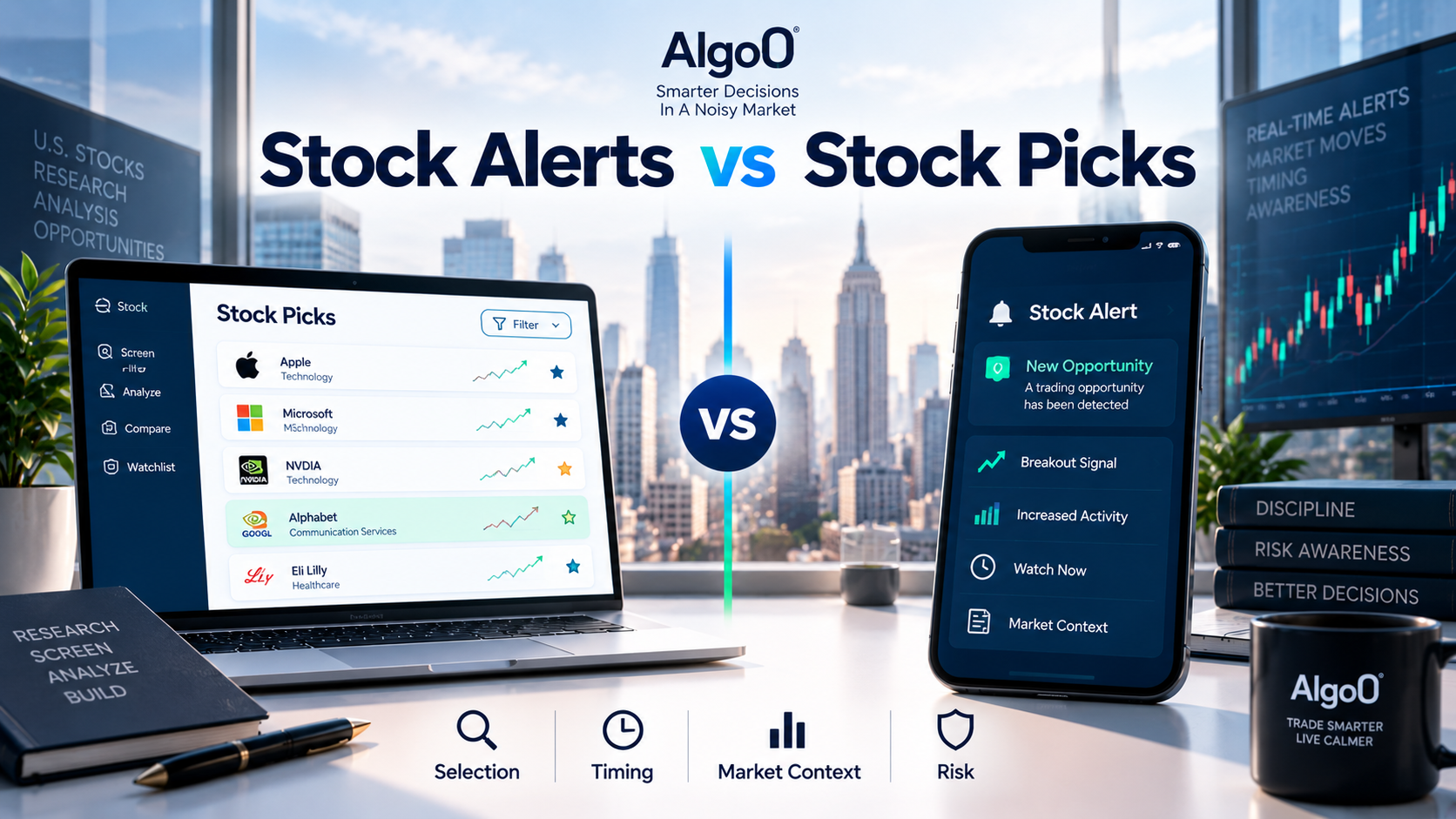
Stock Alert Service vs Stock Picking Service
U.S. stocks can move quickly. Earnings reports, economic data, interest-rate expectations, sector rotation, institutional activity, liquidity changes, market sentiment, and unexpected news can all influence stock prices within a single trading session.
Stock Alerts
Bring relevant market movements, events, or trading opportunities to your attention when predefined conditions occur.
Stock Picks
Identify specific stocks that may deserve further research, monitoring, or consideration.
Trading Signals
Use predefined rules and conditions to identify potential trading setups rather than simply listing stocks.
Risk Awareness
Evaluate alerts and stock picks together with volatility, liquidity, drawdown, portfolio exposure, and uncertainty.
- Stock Alert Service vs Stock Picking Service
- What Is a Stock Alert Service?
- What Is a Stock Picking Service?
- Stock Alert Service vs Stock Picking Service Comparison
- Stock Alerts vs Stock Recommendations
- Stock Alerts vs Trading Signals
- Stock Picking Service vs Stock Screener
- Why Traders Use Stock Alert Services
- Why Investors Use Stock Picking Services
- Real-Time Stock Alerts
- Stock Alerts and Risk Management
- Historical Performance
- Stock Alerts vs Automated Trading
- Stock Alerts vs Copy Trading
- Stock Alerts vs AI Stock Pickers
- Systematic Trading and Stock Alerts
- How to Choose the Right Service
- What Should You Compare?
- Why Too Many Alerts Can Hurt
- Awareness vs Action
- Portfolio Management
- Why Methodology Matters
- Common Mistakes
- How Algo0 Fits Into the Process
- Who Is Algo0 Built For?
- Practical Comparison Checklist
- Frequently Asked Questions
What Is the Difference Between a Stock Alert Service and a Stock Picking Service?
The simplest distinction is:
Timing & Awareness
Helps bring a market opportunity or stock movement to your attention.
- Market notifications
- Price movements
- Breakouts
- Momentum
- Trading alerts
Selection & Research
Helps identify specific stocks that may deserve attention or further research.
- Curated stock ideas
- Watchlists
- Stock selection
- Research starting points
- Selection methodology
Neither model is automatically better.
The right choice depends on your trading style, investment horizon, decision-making process, need for timing, research preferences, risk tolerance, and level of market experience.
What Is a Stock Alert Service?
A stock alert service is a service that monitors market conditions and provides notifications when specific events, movements, or conditions occur.
Stock alerts can include:
- Price alerts.
- Breakout alerts.
- Momentum alerts.
- Trend alerts.
- Market alerts.
- Trading alerts.
- Entry alerts.
- Exit alerts.
- Volatility alerts.
- Portfolio alerts.
- U.S. stock alerts.
- Real-time stock notifications.
The exact functionality depends on the provider and methodology.
What Is a Stock Picking Service?
A stock picking service focuses on identifying stocks that may deserve attention.
Stock selection may be based on:
- Fundamental analysis.
- Technical analysis.
- Momentum.
- Relative strength.
- Earnings.
- Sector performance.
- Quantitative models.
- Trading rules.
- Market trends.
- Valuation.
A stock picking platform can help reduce the number of companies a user needs to research manually.
Instead of reviewing thousands of U.S. stocks, the user may receive a smaller list of stocks that fit a particular methodology.
Stock Alert Service vs. Stock Picking Service
| Factor | Stock Alert Service | Stock Picking Service |
|---|---|---|
| Primary Purpose | Highlight opportunities or market events | Identify stocks worth researching |
| Main Focus | Timing and market activity | Selection and filtering |
| Typical Output | Alert, notification, or signal | Stock list, pick, or recommendation |
| Best Use | Ongoing market monitoring | Building a watchlist |
| Timing | Often important | May be less immediate |
| User Decision | Remains with the user | Remains with the user |
| Profit Guarantee | None | None |
These models can also overlap. Some platforms provide both stock picks and alerts.
The important thing is to understand exactly what you are paying for.
Stock Alerts vs. Stock Recommendations
Stock alerts and stock recommendations are often treated as the same thing. They are not necessarily identical.
An Event Happened
A stock alert may communicate that a specific event, movement, or condition has occurred.
A Stock Looks Attractive
A recommendation may communicate that a particular stock is viewed as attractive according to a specific analysis or opinion.
If you want to monitor opportunities and make your own decisions, alerts may be more relevant.
If you want someone or something to narrow the universe of stocks for you, stock selection may be more relevant.
Stock Alerts vs. Trading Signals
Another common comparison is stock alerts versus trading signals.
Market Event
A stock moves above a significant price level, reaches a condition, or experiences a relevant event.
Strategy Condition
A predefined set of rules is satisfied and produces a potential trading setup.
When evaluating a trading signal service, understand:
- What generates the signal?
- Which rules are used?
- What market conditions matter?
- How is the signal delivered?
- What risk information is provided?
- How should the signal be interpreted?
Stock Picking Service vs. Stock Screener
A stock screener and a stock picking service can also look similar, but they serve different functions.
Stock Screener
Find stocks yourself using filters and criteria.
Stock Picking
Receive a selected group of stocks based on a methodology.
Stock Alert
Receive notifications when relevant opportunities or events occur.
Trading Signal
Receive a potential setup generated by predefined rules.
Why Do Traders Use Stock Alert Services?
Following the entire U.S. stock market manually is difficult.
There are thousands of stocks, multiple sectors, continuous news, earnings announcements, changing volatility, and rapidly evolving market conditions.
A trader may spend hours:
- Watching charts.
- Monitoring prices.
- Reading news.
- Checking volume.
- Searching for breakouts.
- Reviewing momentum.
- Updating watchlists.
- Comparing sectors.
The objective is not to eliminate research. It is to organize where the research begins.
Why Do Investors Use Stock Picking Services?
Longer-term investors may not need frequent trading alerts.
They may instead want to identify companies that deserve deeper research.
A stock picking service can help reduce the initial research universe.
But a stock pick should still be evaluated based on:
- Company fundamentals.
- Valuation.
- Industry conditions.
- Competitive position.
- Growth expectations.
- Risk.
- Portfolio exposure.
- Investment horizon.
Real-Time Stock Alerts: Speed vs. Context
Real-time stock alerts are attractive to active traders because timing can matter.
But speed is not the only consideration.
1 What Happened?
Understand the event or market movement behind the alert.
2 Why Does It Matter?
Understand why the opportunity deserves attention.
3 What Is the Context?
Review broader market and sector conditions.
4 What Is the Risk?
Consider volatility, liquidity, execution and portfolio exposure.
Speed creates awareness.
Context improves understanding.
Decision-making remains the user's responsibility.
Stock Alerts and Risk Management
A trading alert should never be evaluated separately from risk.
✓ Position Size
How much capital would be exposed?
✓ Maximum Loss
What level of loss can you realistically tolerate?
✓ Volatility
How quickly can the stock move?
✓ Liquidity
How easily can the position be entered or exited?
✓ Concentration
Does the opportunity increase portfolio concentration?
✓ Exit Strategy
What is your plan if the trade moves against you?
Why Drawdown Matters
Many traders focus heavily on returns. But drawdown is equally important when evaluating a trading methodology.
Ask:
- What was the historical maximum drawdown?
- How long did difficult periods last?
- How consistent was performance?
- What market conditions were present?
- Were results live, historical, or backtested?
- What assumptions were used?
A strategy that produced strong historical returns may also have experienced significant periods of decline.
Performance should therefore be evaluated as a complete picture.
Historical Performance of Stock Alert and Stock Picking Services
Trading services may present:
- Historical returns.
- Backtested results.
- Performance charts.
- Win rates.
- Drawdown.
- Profit factors.
- Historical trade records.
These figures can help users understand how a methodology behaved in the past.
Past Performance Is Not a Promise
Actual outcomes can differ because of execution, liquidity, trading costs, timing, market conditions, slippage, user behavior, and changes in market structure.
Historical performance should be treated as context for evaluation, not a promise.
Stock Alert Service vs. Automated Trading
An automated system may reduce manual intervention.
An alert service gives the user greater control over whether to act.
Neither approach eliminates risk.
Stock Alerts vs. Copy Trading
Copy trading allows users to follow or replicate another strategy or trader.
Stock alerts operate differently.
Information
The alert provides information. The user evaluates the opportunity and decides whether to act.
Strategy Following
The user follows or replicates another strategy or trader, depending on the service.
Therefore, copy trading and stock alerts should not be treated as interchangeable services.
Stock Alert Services vs. AI Stock Pickers
AI stock pickers and AI trading tools are increasingly popular.
But the presence of artificial intelligence does not automatically make a service better.
When evaluating an AI stock tool, consider:
- Data sources.
- Methodology.
- Signal generation.
- Historical testing.
- Risk controls.
- Transparency.
- Explainability.
- Limitations.
Rule-Based Stock Alerts
Rule-based systems can provide consistency by applying predefined criteria repeatedly.
Instead of relying entirely on subjective opinions, a rule-based system can evaluate opportunities according to specific conditions.
✓Greater Consistency
✓Repeatable Evaluation
✓Reduced Emotional Influence
✓Clearer Methodology
✓Structured Decisions
However, rule-based trading does not eliminate risk.
A rule can identify a setup. It cannot guarantee the outcome.
Systematic Trading and Stock Alerts
Stock alerts can be one output of a broader systematic process.
How to Choose the Right Service for Your Trading Style
Start by identifying what you actually need.
Faster Awareness?
A stock alert service may be appropriate.
Curated Stocks?
A stock picking service may be more relevant.
Strategy Signals?
Consider a trading signal service.
Market Search?
A stock screener may be enough.
Automated Execution?
Consider an automated trading platform.
Follow Another Strategy?
Copy trading may be closer to your needs.
Deeper Research?
An investment research service may be more appropriate.
What Should You Compare Before Buying a Stock Trading Service?
Do not compare subscription prices alone.
1 Methodology
How are opportunities identified?
2 Market Coverage
Does the service focus on the markets you actually trade?
3 Alert Type
Are you receiving alerts, signals, or stock picks?
4 Timing
How quickly are relevant notifications delivered?
5 Context
Do you understand why the opportunity matters?
6 Risk Information
Are volatility, drawdown, liquidity, and uncertainty addressed?
7 Historical Performance
Are historical results presented clearly and responsibly?
8 Transparency
Does the provider avoid unrealistic promises?
9 Workflow
What should you do after receiving an alert?
10 Cost
Does the subscription provide enough value for your use case?
What Makes a Good Stock Alert Service?
There is no universal best stock alert service for every trader.
However, a strong service should provide several important characteristics:
- Clear market focus.
- Relevant alerts.
- Understandable signals.
- Defined methodology.
- Market context.
- Risk awareness.
- Transparent communication.
- Historical context.
- Clear subscription terms.
- User control.
Why Too Many Stock Alerts Can Hurt Decision-Making
More information is not always better.
If a trader receives dozens of alerts every day, the result may be:
- Alert fatigue.
- Overtrading.
- Reduced selectivity.
- Emotional decisions.
- FOMO.
- Poor position sizing.
The best alert workflow should help answer:
This is why signal quality and context can matter more than notification volume.
The Difference Between Awareness and Action
An Alert Is Information, Not an Instruction.
Receiving an alert does not mean you must trade.
You may:
- Enter a position.
- Wait.
- Conduct more research.
- Add the stock to a watchlist.
- Reduce exposure.
- Ignore the opportunity.
The ability to make that decision independently is important.
A Stock Alert Does Not Guarantee a Successful Trade
No responsible stock alert service can guarantee that every alert will produce a profitable trade.
Markets can change because of:
- Unexpected news.
- Earnings.
- Economic data.
- Interest-rate decisions.
- Sector weakness.
- Liquidity changes.
- Market-wide selling.
- Volatility spikes.
A signal can be logical and still fail.
A setup can look attractive and still reverse.
That uncertainty is part of trading.
Portfolio Management and Stock Alerts
A stock opportunity should not always be evaluated in isolation.
Suppose your portfolio already contains several technology stocks. Receiving another technology stock alert may increase concentration.
Similarly, multiple stocks can have high correlation.
Therefore, consider:
- Sector exposure.
- Position size.
- Portfolio concentration.
- Correlation.
- Total market exposure.
- Risk budget.
Market Context Makes Stock Alerts More Useful
The same stock signal can behave differently under different market conditions.
Consider a breakout.
During a strong market, the breakout may have supportive conditions. During a broad market selloff, the same breakout may fail quickly.
This is why traders should consider:
- Market trend.
- Sector strength.
- Volatility.
- Liquidity.
- Earnings calendar.
- Economic events.
- Investor sentiment.
A signal becomes easier to interpret when it is connected to the environment around it.
Stock Alerts and Market Timing
No service can consistently identify the perfect market top or bottom.
Market timing is inherently uncertain.
Stock Alerts and Trading Psychology
Trading decisions are influenced by psychology.
!Fear of Missing Out
!Fear of Loss
!Overconfidence
!Revenge Trading
!Confirmation Bias
!Recency Bias
!Panic Selling
!Chasing Momentum
A structured alert process can create a useful pause between market movement and user reaction.
The Purpose Is Not to Eliminate Emotion
The purpose is to prevent emotion from becoming the trading strategy.
Common Mistakes When Buying Stock Services
1 Focusing Only on Win Rate
Win rate does not tell you everything about risk or drawdown.
2 Chasing Historical Returns
Past performance does not guarantee future results.
3 Choosing Marketing Claims
Aggressive promises do not replace methodology.
4 Choosing Only by Price
Price alone does not determine value.
5 Choosing the Most Alerts
More alerts can create more noise.
6 Following Every Signal
An alert is not a command.
7 Ignoring Portfolio Risk
A good stock can still be a poor addition to a concentrated portfolio.
How Algo0 Fits Into the Decision Process
Algo0 focuses on U.S. stock opportunities through a more structured process.
This makes the alert part of a broader workflow rather than an isolated notification.
Why Methodology Matters
You cannot properly evaluate a stock alert or stock picking service without understanding the methodology behind it.
Important questions include:
- Why is this stock selected?
- What conditions generate the signal?
- How are opportunities filtered?
- What market factors matter?
- How is risk considered?
- How are historical results evaluated?
A clear methodology gives users a better basis for evaluating the service.
Why Performance Matters
Performance can provide historical context.
But performance should be evaluated alongside:
- Drawdown.
- Volatility.
- Market conditions.
- Time period.
- Methodology.
- Execution.
- Historical versus live results.
Why Risk Disclosure Matters
Any serious trading service should make its limitations clear.
!Market Risk
!Volatility Risk
!Drawdown Risk
!Liquidity Risk
!Execution Risk
!Gap Risk
!Historical Performance Risk
!User Decision Risk
Why Transparency Matters Before Subscription
Before subscribing to any stock alert or stock picking service, you should understand:
- What you receive.
- How signals are generated.
- How alerts are delivered.
- What markets are covered.
- What methodology is used.
- How performance is presented.
- What risks exist.
- What the service does not guarantee.
- What remains your responsibility.
A trustworthy service should make these points easier to understand.
Stock Alert Subscription vs. Stock Picking Subscription
Timely Awareness
- Timely notifications.
- Market monitoring.
- Trading opportunities.
- Real-time awareness.
- Signal delivery.
Curated Ideas
- Curated stock ideas.
- Watchlists.
- Stock research.
- Selection criteria.
- Reduced research workload.
Some services combine both.
In that case, evaluate whether the combined workflow actually adds value to your trading routine.
A Practical Comparison Checklist
Before subscribing, ask:
✓ About the Service
- What exactly do I receive?
- How often are alerts delivered?
- What markets are covered?
✓ About Methodology
- How are stocks selected?
- How are signals generated?
- Are the rules clearly explained?
✓ About Risk
- Are drawdowns disclosed?
- How is volatility addressed?
- What are execution limitations?
✓ About Performance
- Are results historical or live?
- Are backtested results identified?
- Are performance metrics explained?
✓ About Fit
- Does it fit my trading horizon?
- Does it fit my risk tolerance?
- Does it fit my portfolio?
✓ About Cost
- What is the subscription price?
- What features are included?
- Is the value clear?
Who Is Algo0 Built For?
Algo0 may be relevant for users who:
- Follow U.S. stocks.
- Want structured market information.
- Prefer systematic decision support.
- Want to reduce manual market scanning.
- Compare stock alert subscriptions.
- Compare stock picking services.
- Follow swing trading opportunities.
- Want clearer signal context.
- Prefer risk-aware communication.
A stock alert or picking service may not be necessary for someone who already has an advanced market-scanning system, prefers completely independent research, does not actively follow U.S. equities, or expects guaranteed returns.
Responsible Use of Stock Alerts
Use stock alerts as part of a broader decision process.
- Treating alerts as guaranteed outcomes.
- Risking money you cannot afford to lose.
- Following every alert automatically.
- Ignoring portfolio concentration.
- Assuming historical returns will repeat.
- Understand the alert.
- Review the context.
- Assess the risk.
- Compare it with your strategy.
- Then decide.
From Stock Alerts to a Complete Trading Workflow
The real value of a stock alert can come from what happens after you receive it.
Receive the Alert
Identify the stock and opportunity.
Understand the Signal
Determine why it appeared.
Review Market Conditions
Look at the broader market and sector.
Assess Risk
Consider volatility, liquidity, drawdown and position size.
Review Portfolio Fit
Consider existing exposure.
Compare With Your Strategy
Does the opportunity fit your trading plan?
Make the Decision
Trade, wait, research further, or ignore the opportunity.
This approach transforms an alert from a simple notification into a potential starting point for disciplined decision-making.
Related U.S. Stock Trading Concepts
The stock alert and stock picking landscape overlaps with:
•Stock Alert Services
•U.S. Stock Alerts
•Real-Time Stock Alerts
•Trading Signals
•Stock Picks
•Stock Screeners
•Investment Research
•Systematic Trading
•Algorithmic Trading
•Risk Management
•Copy Trading
•AI Stock Trading Tools
Frequently Asked Questions
What is the difference between a stock alert service and a stock picking service?
A stock alert service focuses on notifying users about relevant market movements or opportunities, while a stock picking service focuses on identifying specific stocks that may deserve attention or research.
Is a stock alert service better than a stock picking service?
Not necessarily. The right choice depends on your trading style. Traders focused on timing may prefer alerts, while users looking for curated stock ideas may prefer stock picking.
What is the best stock alert service?
The best service depends on your needs, strategy, market, experience, and risk tolerance. Look for clear methodology, relevant alerts, market context, risk awareness, transparency, and a workflow that supports independent decisions.
What is the difference between a stock pick and a stock alert?
A stock pick identifies a stock that may be worth monitoring. A stock alert notifies the user when a particular event, movement, or condition occurs.
Are real-time stock alerts guaranteed to improve execution?
No. Faster information does not guarantee a particular execution price. Execution depends on market conditions, liquidity, order type, broker infrastructure, timing, and other factors.
Are stock alerts the same as trading signals?
Not necessarily. A stock alert can communicate an event or movement, while a trading signal may be generated when specific strategy conditions are met.
Are paid stock alert services better than free tools?
Not automatically. Paid services may offer additional methodology, context, research, or structured workflows, but the value depends on whether those features are useful for your specific needs.
How many stock alerts should I receive?
There is no universal number. Too many alerts can create information overload and encourage overtrading. Relevance and quality are generally more important than volume.
Are stock alerts useful for swing trading?
They can be. Swing traders may use alerts to monitor breakouts, momentum, trends, pullbacks, and other opportunities.
What is the difference between a stock screener and a stock picking service?
A stock screener helps users filter the market using their own criteria. A stock picking service generally provides a selected list of stocks based on a particular methodology.
Does a stock picking service guarantee that a stock will rise?
No. A stock pick is not a guarantee of future price performance.
Does Algo0 provide U.S. stock signals?
Algo0 provides a structured framework for following U.S. stock opportunities through systematic signals, alerts, market context, and risk-aware decision support.
Can I use Algo0 with my own trading strategy?
Users can evaluate the information and signals within their own trading process while considering their objectives, risk tolerance, and portfolio circumstances.
Is Algo0 a financial advisor?
The service should not be treated as a substitute for personalized financial advice. Users remain responsible for their own trading and investment decisions.
Can historical performance be used to choose a stock alert service?
Historical performance can provide useful context, but it does not guarantee future results. It should be considered alongside drawdown, volatility, methodology, market conditions, and execution assumptions.
Should I trade every time I receive an alert?
No. An alert is information, not a requirement to trade. You may investigate, wait, monitor, or ignore the opportunity.
What should I look for in a trading signal service?
Look for a defined methodology, understandable signals, market context, risk information, historical context, transparency, and a process that supports independent decision-making.
Before You Subscribe to a Stock Alert or Stock Picking Service
Ask Yourself
- Do I understand the service?
- Do I understand the methodology?
- Do I know what information I will receive?
- Do I understand the risks?
- Are historical results presented clearly?
- Does the service fit my trading style?
- Does the subscription provide meaningful value?
- Do I remain responsible for my own decisions?
The clearer these answers are, the easier it becomes to compare providers.
Compare the Service, Not Just the Marketing
When evaluating a stock alert service vs stock picking service, avoid choosing based only on:
- The number of alerts.
- Marketing language.
- Historical return screenshots.
- Claimed win rates.
- Social media popularity.
- Subscription price.
| What to Evaluate | Key Question |
|---|---|
| Methodology | How are opportunities identified? |
| Timing | When do alerts arrive? |
| Context | Why does the opportunity matter? |
| Risk | What can go wrong? |
| Performance | How has the methodology behaved historically? |
| Fit | Does it work with your strategy? |
| Transparency | Are limitations clearly communicated? |
A More Structured Way to Follow U.S. Stock Opportunities
The market will always produce noise.
There will always be new stock picks, breaking news, trading signals, AI predictions, social media calls, market alerts, and automated trading tools.
You do not need to follow everything.
You need a process that helps you determine:
- What deserves attention?
- Why does it matter?
- What does the signal mean?
- What are the risks?
- Does the opportunity fit my plan?
Algo0 is designed around this type of structured decision process.
Evaluate Algo0 Before You Subscribe
Review the methodology, performance, risk disclosure, pricing, and overall fit before deciding whether Algo0 belongs in your U.S. stock trading workflow.