


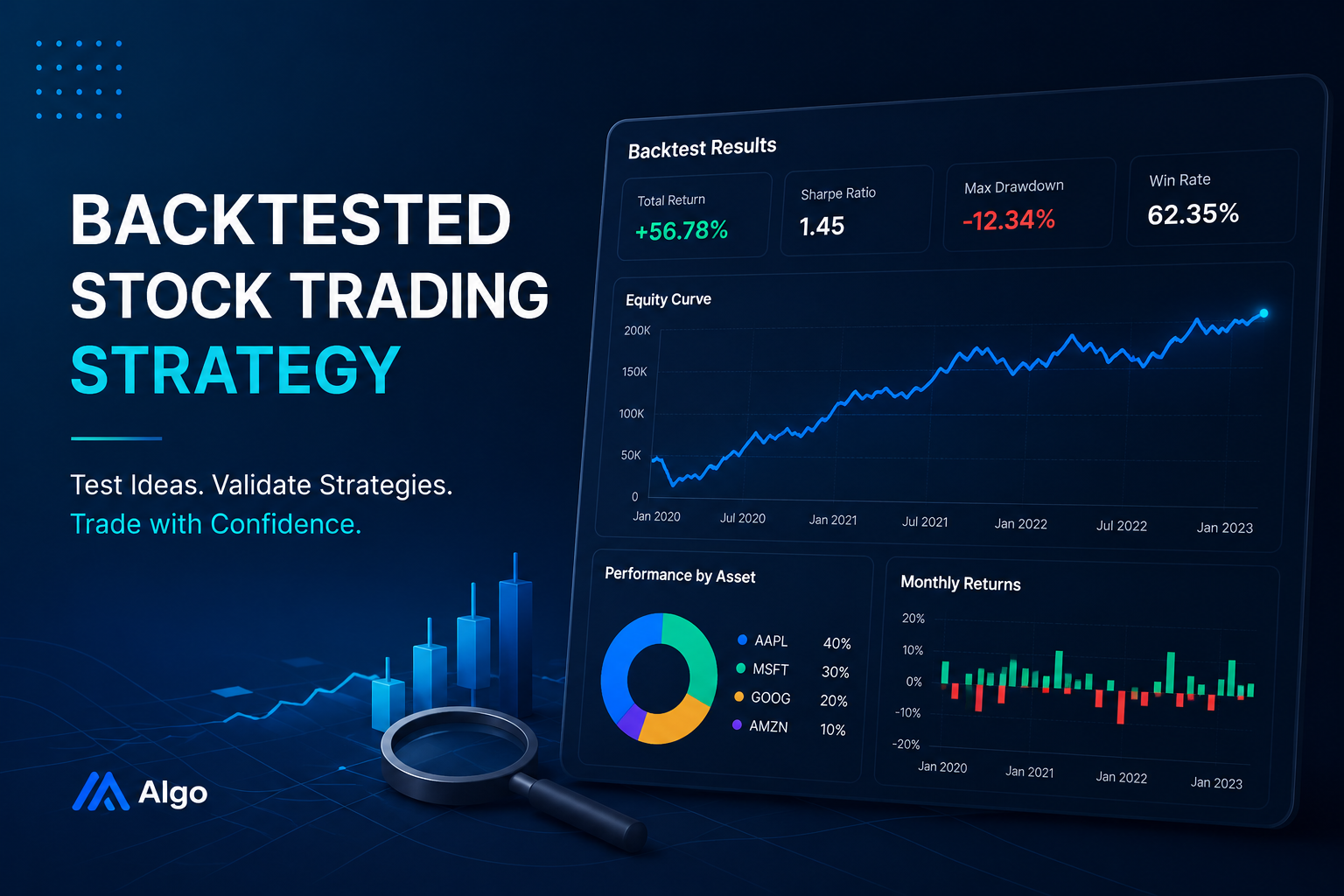
Backtested Stock Trading Strategy: A Structured Way to Evaluate U.S. Stock Opportunities
A backtested stock trading strategy gives traders and investors a structured way to examine how a defined trading approach would have behaved under historical market conditions. But historical performance is only the starting point. A stronger evaluation combines tested rules, market context, risk awareness, and disciplined execution.
What Is a Backtested Stock Trading Strategy?
A backtested stock trading strategy is a systematic trading approach evaluated against historical market data to understand how its rules would have behaved during previous market conditions.
Instead of evaluating a stock only by its current price movement or a market opinion, backtesting allows traders to examine a defined process: when a trade would have been triggered, how positions would have been managed, what happened during losing periods, and how the strategy behaved across different market environments.
This distinction matters because markets continuously change. A strategy that produced strong historical results can behave differently when volatility, liquidity, market structure, or investor sentiment changes.
For that reason, historical performance should always be considered alongside the strategy's assumptions, drawdown, execution conditions, and risk profile.
Why Backtesting Matters Before Using a Trading Strategy
U.S. stock markets can move quickly. Earnings reports, interest-rate expectations, sector rotation, institutional flows, economic releases, and sudden volatility can change the market environment within a single session.
Without a defined methodology, traders can easily move from one idea to another based on headlines, social media, short-term price movements, or emotional reactions.
Backtesting introduces a more structured starting point. The rules can be defined first and then evaluated against historical data before considering how the approach may fit a live trading environment.
Test a Defined Idea
Evaluate whether a specific set of trading rules produced meaningful historical behavior rather than relying only on a compelling narrative.
Understand Weak Periods
Review losing periods and drawdowns instead of focusing only on the strongest historical trades.
Reduce Emotional Decisions
A rules-based process can create a more consistent framework than reacting to market noise.
Compare Strategies
Different approaches can be evaluated using structured factors instead of recent wins alone.
How a Backtested Trading Strategy Is Evaluated
A useful evaluation process goes beyond calculating one headline return. The objective is to understand how the strategy behaves, where it performs well, where it struggles, and what risks may appear when market conditions change.
Define the Rules
Establish entry, exit, filtering, and risk-management conditions.
Test Historical Data
Apply the rules to historical U.S. stock market data.
Review Performance
Examine returns, consistency, winning and losing periods.
Examine Risk
Review drawdown, volatility, exposure, and assumptions.
Evaluate Live Fit
Consider whether the methodology fits current market conditions.
A Backtest Does Not Exist in Isolation
Historical strategy performance can look very different depending on the market environment in which it was tested. U.S. equities experience trending markets, corrections, volatility spikes, sector rotations, and unexpected reactions to economic or corporate events.
A strategy that performs well during a strong upward trend may behave differently during a risk-off environment. Likewise, a momentum-based approach may behave differently from a defensive or mean-reversion methodology.
Market context therefore remains an important part of evaluating a backtested stock trading strategy.
Examples of Market Context
- Broad market trend and index direction
- Sector strength and rotation
- Earnings and corporate announcements
- Interest-rate expectations
- Market volatility and liquidity
- Momentum and relative strength
- Investor risk sentiment
More Than a Stock Ticker or a Quick Alert
Many trading services reduce an opportunity to a stock symbol and a direction: buy or sell. That may be useful for speed, but speed alone does not explain why the opportunity exists or how it fits into a broader plan.
A structured approach considers the logic behind the opportunity, the market environment, the expected time horizon, and the potential downside before a decision is made.
Risk Management Is Part of the Strategy
One of the most important parts of evaluating a backtested stock trading strategy is understanding what happened when the strategy did not work.
Looking only at total return can hide periods of significant drawdown or volatility. A strategy may show attractive historical performance while also experiencing periods where its value declined materially.
Responsible evaluation therefore considers multiple dimensions instead of relying on one headline number.
Maximum Drawdown
Understand the largest historical decline from a previous peak.
Volatility
Evaluate how significantly performance can fluctuate over time.
Liquidity
Consider whether historical assumptions remain realistic under actual conditions.
Position Sizing
Consider the amount of capital exposed to each trade or position.
Past performance and backtested results do not guarantee future results.
Actual trading can differ from historical testing because of changing market conditions, liquidity, execution, slippage, spreads, data assumptions, and other factors.
No trading strategy can eliminate market risk or guarantee profits. Backtesting should be treated as a research and evaluation tool, not a promise of future performance.
Comparing Trading Signals, Stock Picks, and Systematic Strategies
Traders searching for automated stock trading, stock alerts, stock picks, AI trading bots, or systematic strategies may encounter many different types of services.
The important question is not simply which label sounds best. It is whether the underlying process is understandable, structured, and appropriate for the user's objectives.
| Approach | Typical Focus | What to Evaluate |
|---|---|---|
| Stock Alert | Notify users about a potential market opportunity or movement. | Timing, context, frequency, and clarity. |
| Stock Pick | Highlight selected stocks that may deserve attention. | Selection methodology, rationale, and risk. |
| Trading Signal | Provide a potential entry, exit, or trading setup. | Rules, timing, invalidation, and risk. |
| Systematic Strategy | Apply predefined rules repeatedly across market opportunities. | Historical behavior, robustness, and assumptions. |
| Automated Trading | Use technology to execute defined trading instructions. | Strategy logic, controls, execution, and account risk. |
From Opportunity to Action
A disciplined trading workflow begins before the trade is placed. The trader identifies the opportunity, understands the environment, evaluates the strategy logic, considers downside, and then decides whether the opportunity belongs in the current plan.
This creates an important distinction between receiving information and making a decision. An alert can tell you that something is happening. A structured methodology can help explain what the event means within a larger decision process.
Common Mistakes Traders Should Avoid
Many trading mistakes happen before an order is ever placed. Fast-moving markets can create urgency and encourage decisions based on incomplete information.
Who Is a Backtested Trading Approach Built For?
A structured approach can be useful for traders and investors who want to move beyond random stock tips and understand the methodology behind an opportunity.
Active Traders
Traders who want systematic information to support short-term or swing-trading decisions.
Investors
Investors who want to understand historical behavior before considering a systematic approach.
Service Comparers
Users comparing stock alerts, stock picks, automated tools, and systematic services.
Risk-Aware Users
Traders who want drawdown, volatility, and uncertainty to remain visible.
Built Around Structure, Transparency, and Systematic Thinking
Algo provides access to algorithmically generated portfolio trades for U.S. stocks, with systematic investment systems built around professional rules and criteria for identifying opportunities and managing risk.
According to the platform, its systems have been developed and backtested over more than 25 years on the U.S. market before being applied to real investment portfolios whose performance can be tracked live.
The objective is not to promise that every trade will succeed. The focus is on creating a disciplined, rules-based approach that reduces emotional decision-making and makes the trading process more structured.
Frequently Asked Questions
What is a backtested stock trading strategy?
Does backtesting guarantee future profits?
Why is drawdown important when evaluating a strategy?
Is a backtested strategy the same as automated trading?
Can beginners use a systematic trading approach?
What should I review before following a trading strategy?
How is Algo different from random stock tips?
A Smarter Starting Point for U.S. Stock Decisions
A backtested stock trading strategy can provide valuable insight into how a systematic approach behaved historically. But the strongest evaluation goes beyond a single performance figure.
Traders should look at the rules behind the strategy, the market conditions in which it was tested, the periods when it struggled, the level of drawdown and volatility, and the assumptions that may affect real-world execution.
For traders and investors interested in systematic exposure to U.S. stocks, combining historical research with market context, risk awareness, and disciplined execution can create a clearer framework for evaluating opportunities.
Explore a More Systematic Way to Approach U.S. Stocks
Explore Algo's portfolios, review the available plans, and learn how systematic trading technology can fit into your investment process.