


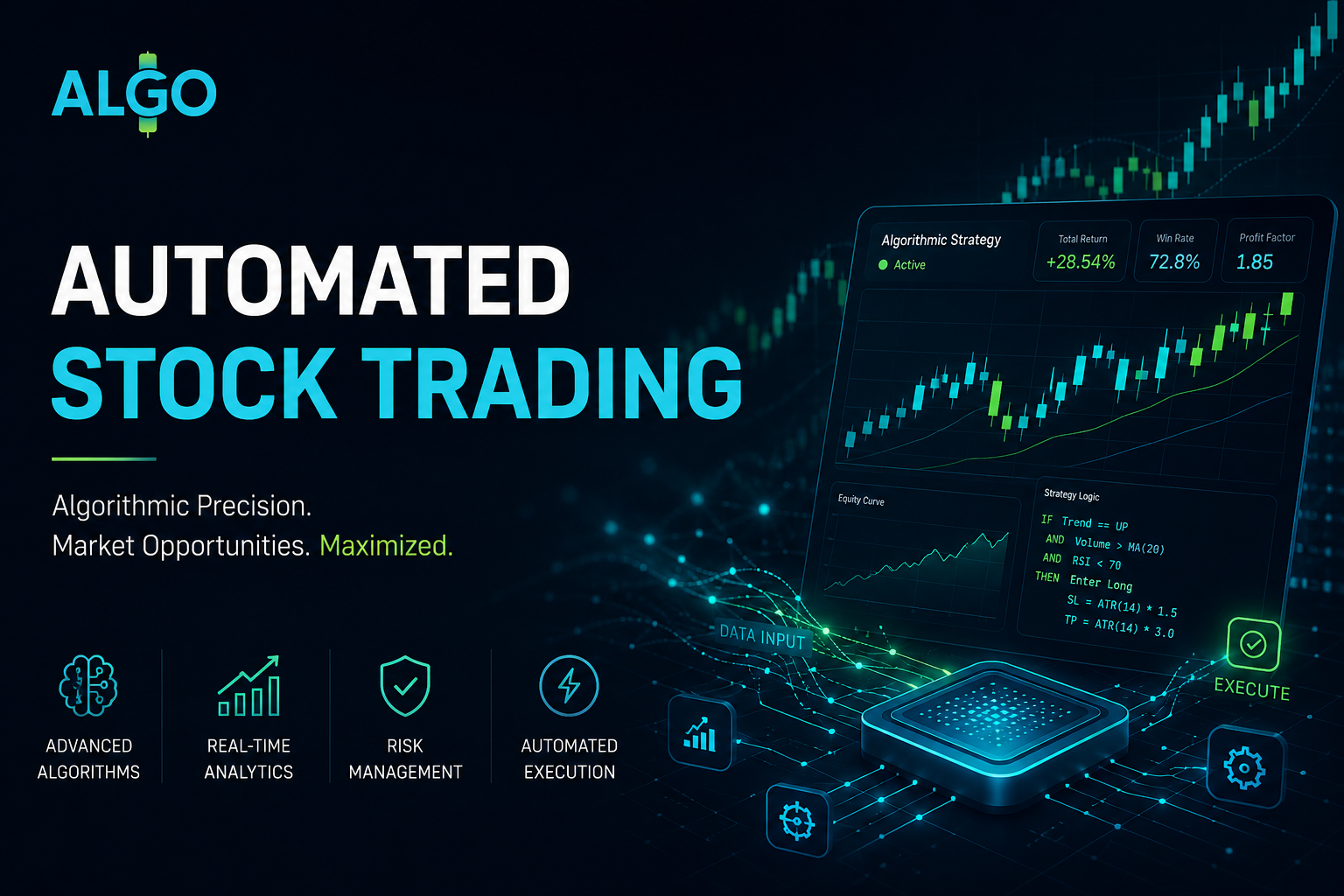
A Clearer Way to Read US Stock Opportunities
Algo gives US stock traders and investors a more structured way to evaluate market opportunities through automated stock trading. Instead of relying on scattered opinions, noisy market discussions, or emotional reactions to every market move, the process brings market context, rule-based logic, performance awareness, and responsible risk review together.
The US stock market can move quickly. Earnings reports, Federal Reserve expectations, liquidity changes, sector rotation, analyst revisions, and volatility spikes can all change the quality of an opportunity.
A structured approach helps users review an opportunity before making a trading or investing decision.
What Automated Stock Trading Helps You Do
Most traders do not suffer from a lack of information. They suffer from too much information without a reliable filter. A stock can move because of earnings, volume, technical momentum, sector strength, macro news, or speculation.
Follow US stock opportunities with clearer context instead of disconnected market noise.
Understand the logic behind signals, alerts, stock picks, automation, methodology, and performance updates.
Review risk before acting, including drawdown, volatility, market gaps, execution uncertainty, and user responsibility.
Compare automated trading tools, stock alert services, stock-picking subscriptions, and systematic trading solutions.
Move from curiosity to confidence by reviewing methodology, performance, pricing, risk disclosure, and service details.
Create a cleaner path from identifying an opportunity to evaluating whether it fits your own trading plan.
How the Algo Platform Workflow Fits Together
A systematic trading workflow connects market analysis, filtering, signals, risk context, and the final user decision into one clearer process.
Market Review
US market conditions, sector behavior, volatility, and opportunity context are reviewed.
Rule-Based Filtering
Potential opportunities are filtered through defined criteria and a repeatable process.
Signal or Output
Relevant signals, alerts, stock ideas, portfolio updates, methodology information, or service details are presented.
Risk Context
Drawdown, uncertainty, volatility, and responsible-use considerations remain part of the evaluation.
User Decision
The user reviews the information and decides whether the opportunity or service fits their own objectives.
Why Structured Trading Information Matters
A market opportunity is only useful when the user understands how to interpret it. Speed alone does not create a better trading decision.
A Fast Alert Can Create Pressure
Receiving a notification without understanding the wider market context can encourage reactive decisions.
A Stock Pick Can Create False Confidence
An opportunity should be evaluated together with uncertainty, volatility, and the possibility of loss.
Automation Can Become Blind Reliance
Users should understand the logic and methodology behind a systematic process rather than simply following outputs.
Performance Can Be Misleading
Performance information should be reviewed with appropriate context, including historical drawdown and market conditions.
Compare the Process Before You Subscribe
A serious trading decision starts with methodology, performance context, and risk awareness.
Who Is Automated Stock Trading Built For?
The approach is designed for users who want more structure, transparency, and discipline when following US stock opportunities.
Traders who want structured US stock opportunities and clearer trade context.
Investors who want stock ideas supported by a defined process rather than informal recommendations.
Users comparing stock signals, alerts, trading tools, bots, or stock-picking subscriptions.
Investors outside the US who want a clearer way to follow opportunities in US equities.
People who value methodology, drawdown context, risk disclosure, and transparent pricing.
Clarity Over Hype
Serious users want to understand how the service works, how risk is handled, what performance means, and what happens after subscribing.
The focus is on methodology, transparency, and responsible decision support.
Users can understand the logic and structure behind the trading process.
Performance should be considered together with its historical and risk context.
Market risk, volatility, drawdown and execution uncertainty remain visible.
Users can move naturally between methodology, performance, pricing, risk information and service details.
Benefits of Using a Structured Trading Approach
More Structure
Market information is presented inside a clearer decision-making process.
Less Emotional Trading
Context and risk awareness can encourage users to review information before acting.
Better Comparison
Signals, alerts, automation, pricing, and methodology can be evaluated together.
Trust Through Transparency
Methodology, performance context, and risk disclosure create a clearer commercial experience.
Cleaner Next Step
Users know whether to explore the service, methodology, performance, pricing, or risk information.
Automated Trading Does Not Remove Market Risk
A systematic process is designed to make the evaluation process more consistent. It is not designed to promise perfect outcomes.
Risk Should Always Remain Part of the Decision
Every trading-related decision involves risk. Prices can move quickly, liquidity can change, orders can execute differently than expected, and market conditions can invalidate an idea.
Past performance, backtested logic, or historical examples do not guarantee future results.
Users should review the available information, understand the associated risks, and decide whether the opportunity fits their own objectives and risk tolerance.
Important: Algo provides technology, structured information, and decision-support tools. Trading and investing involve risk, and no system can guarantee profits or eliminate losses. Users remain responsible for their own trading and investment decisions.
Frequently Asked Questions
Common questions about automated stock trading, methodology, risk, and decision support.
What is automated stock trading?
Automated stock trading is a structured approach to evaluating US stock opportunities using defined logic, market context, systematic processes, and risk-aware information.
Does automated stock trading guarantee profitable trades?
No. Trading and investing involve risk. Automated systems can help create a more structured process, but they cannot guarantee profitable trades or future returns.
How does Algo support better trading decisions?
The approach connects market information, signals, alerts, stock ideas, methodology, performance context, pricing, and risk disclosure into a clearer workflow.
Who is this approach best suited for?
It is suited for traders and investors who want more structure, transparency, and risk awareness when following opportunities in US equities.
What should I review before subscribing to a trading service?
Review the methodology, performance context, risk disclosure, plan features, pricing, and whether the service fits your own objectives and risk tolerance.
Is automated trading safer than manual trading?
Automation does not automatically make trading safer. Its primary value is creating a more systematic and repeatable process. Market risk, execution risk, volatility, and losses can still occur.
Does past performance guarantee future results?
No. Historical performance and backtested results are not guarantees of future performance. They should always be considered within their appropriate methodology and risk context.
Ready to Evaluate Automated Stock Trading?
Start with the service most relevant to your trading style, then review methodology, performance, risk disclosure, and pricing before making a decision.